Thursday, October 25, 2018

"Joyful"

Yesterday I watched you chase leaves.
The wind blew and you dropped everything. 
You squealed. 
You leaped.
You held them in your fists.
You jostled each other.
You squinted into the sun.

And then the wind stopped.
And you, my students, stopped too.
A few final yellow leaves came fluttering down around you.

Your cheeks were flushed red and I could tell you felt alive.

You breathed deeply, turned, 
and returned to what we had been doing as a class.

I saw so deep into each of you, my students; my students
who have so much responsibility 
stacked on your growing shoulders. 
You, my students who have been told as you've gotten older
that you can be anything 
when someday arrives on the horizon.

"What do you want to be when you grow up?"
they ask.

After today, I hope your answer is always "Joyful."


Thursday, October 18, 2018

Windhorse

Albert Einstein once famously remarked that "The world is a dangerous place to live; not because of the people who are evil, but because of the people who don't do anything about it."

Over the course of this school year I've found myself thinking about this. I've thought about what it means to be a bystander (a person who is present at an event or incident but does not directly take part) and what it means to be an upstander (someone who recognizes when something is wrong and acts to make it right). I think of myself as the latter, but I also recognize that I have unconscious biases of my own. So what happens when the evil is a bias, but it's unconscious? What happens when it stems from a power structure I didn't ask for, but that I've benefitted from? What if I'm one of those who "don't do anything about it" because the it is inside of me?

As a heterosexual white male I understand that there are privileges afforded me by society that others have to work harder for. I like to think I do my best to be an upstander for equality in areas of gender, sex, sexual orientation, and race.

But when I plant myself in that camp, and when I look at the world through a lens that says "I'm an ally"...or "I'm with her"...or "I'm with them"...or whatever the thing I tell myself on a random Thursday might be, I am failing myself because I am not always growing. I am neglecting myself the opportunity to see my own blind spots and to identify my own unconscious biases. I am often standing with someone or something, instead of standing for it.

I want to stand for.

I am now beginning to realize I need to be self critical, to look at my own actions and engagements with the world around me through a lens of criticism and self-evolution.

I am not suggesting that I should be overly hard on myself. Instead, I've endeavored to listen to the messages the people around me are sending, and to consider how my interactions with others might be employing my own unconscious power in harmful ways or in the form of microagressions.

It's been a realization about intent versus impact.


Story 1:

Much of my own growth comes from the incredible colleagues and students with whom I surround myself. The other day a colleague and I were speaking and the conversation steered toward a political topic. My colleague made a polarized statement. It was clear that they assumed I was in agreement. As I cleared my throat to reply, the colleague stopped.

"Will, I'm so sorry. I just made an assumption about your political leanings. That was unfair. I wish I hadn't said that."

The comment took my breath away. Whether or not I agreed with this person mattered so much less than the fact that they took the risk to acknowledge--in the moment--that they had made an assumption. They owned that moment and I left the conversation inspired and empowered to do the same. To look at every conversation as an opportunity to put my own assumptions, biases, and unconscious utilizations of power in check.

Story 2:

The very next day I congratulated a colleague who had received public recognition for an award. The colleague identifies as female and as I walked by her, I said, "Hey, congratulations that's so great. I'm really happy you received that recognition." She was seated and as I passed, I touched her shoulder.

Immediately, I thought, "why on earth did I do that? What if the roles were reversed and she had touched my shoulder? What message did I just send? I wish I hadn't done that."

I sat through the next meeting and caught up to the colleague afterwards. "Hey, I'm going to err on the side of being awkward, but I'm trying to keep my own actions in check. When I congratulated you, I touched your shoulder and I don't know why I did that. It wasn't my place and if you were at all uncomfortable, I'm sorry."

"Wow, that's not awkward at all. And I didn't think anything of it. But THANK YOU for saying that...I'm so glad you said something."

Story 3:

My students have too many tests. They just do. I hate that tests are the simplest way to measure a student's understanding and growth, but it's just the way things are. I try to deemphasize them, make the review process fun, and to work in as many experiential and kinesthetic projects as I can...but they still have too many tests.

So recently I decided to dwell in that place of keeping my power as their teacher in check. It was uncomfortable, but I felt it was necessary. I told them, "So, I've been thinking about all of you and how hard you work. I think you have too many tests. I know I told you we would have periodic vocabulary tests and quizzes throughout the year, but I've changed my mind. We're not going to. I've rethought how vocabulary will work. What I really care about is that you learn new words and that you employ them in the ways you write and speak. I think there's a better way, so stay tuned."

Now, of course, this was different than the interactions with my colleagues, but I don't think I would have approached my students in this way had I not experienced what it was like to get in touch with owning my own blindspots. I was inspired by one colleague and, I'd imagine, I took that energy and transitioned it into inspiring another colleague.

I am in a powerful position with my students. I am their teacher and I can ask them to do things and they desperately want to achieve and they seek my affirmation and praise. But I need to keep that in check. I need to put myself in their shoes. Sure it's more work to toss out those vocab tests I was planning on using and find new and innovative ways to teach vocabulary, but it's worth it.

I always like to think I listen to my students, but it's easy to fall into the trap of, "Well, we need to assess this skill, or this content, so we're going to do it this way..." but my students won't always question me on it because I'm in power. I have to listen to the energy, their mood, the tone of their voices, and think about what messages I'm sending about their worth, their identities, their lives, their time...and how hard I'm willing to work for them (not just how hard they'll work for me).

And it all starts with listening. It starts with conversation...and with being aware of my own roles and patterns in those conversations.

In The Art of Good Conversation, Sakyong Miphram writes about the warrior tradition of Shambhala in which conversation is linked to the concept of windhorse. "Wind," he writes, "is the notion of movement, energy, and expanse. Horse is the notion of riding that energy" (13).

I love this concept. I endeavor to listen to others in my conversations. To seek their energy and movement of ideas. But I also want to listen to my own role in the conversation and how my unconscious areas of power and bias might be impacting others...and then I want to ride that energy into the rest of my life.

Thursday, October 11, 2018

In Praise of Pain

I recall a distant phrase from my youth:

"pain is weakness leaving the body."

I probably saw it on locker room walls, on NO FEAR t-shirts, and on athletic shoe commercials.

And, while the slogan feels a little intense, there is something valid about what's being said:  When we hurt, we heal, and we are stronger.

There's been quite a bit written about grit and resilience over the past decade, but there have also been thoughtful critiques penned regarding the limitations of grit as a measurement for success. Personally, I think resilience is important, but it doesn't always make for a perfect result...what it does, though, is make you stronger.

When we hurt--when we allow ourselves to suffer through something we care about--the result is almost always worth it.

There are those age-old coaching adages, "you left it all out there" or "you did all you could." And when people say those things, it's not actually about the result or the outcome. Instead, it's about the effort, about the hard work. It's about trying hard.

This week I had to answer a number of questions, posed by my students about my policies for essay submission.

I have my students submit a rough draft. I grade this assignment for completion (does it, for example, have 600 words? If so, they earn a 100%). But I then remind them that I don't want to read anything "rough." I want to read and grade their best work. So, two days later I have them hand in a final draft. Over those 48 hours, though, my hope is that my students are reworking their rough draft. That they are struggling to make it better. That they are going to great lengths to pore over their ideas and better articulate them. Mark Twain once quipped that "the difference between the right word and the almost right word is the difference between lightning and a lightning bug." I think he's right, and I want my students to struggle to make their essays the best they can be. I want them to be frustrated. I want them to get writer's block...because writer's block comes when someone says, "Arrrrgghhhh, I know what I'm capable of and it kills me that I just can't get it onto the paper right now!!!" (Note: Steven King once suggested that bad writers never struggle to write because they just write, whereas great writers are constantly torturing themselves with trying to hone their craft)

I want my students to submit something that they have struggled to write. I want them to hand in a product they are proud of not because they are talented writers, but because there was a painful process to get the right words onto the page.

An educator I follow on Twitter, @Aaron_Hogan, posted this the other day to his PLN (personal learning network):
image.png

I asked my students this question and everyone looked nervously around. They fidgeted around because they knew what they were supposed to say, how they were supposed to feel, but it wasn't their reality right now.

Sports and art often follow this same reality. Any musician or athlete would tell you that they'd much rather train with people who are a little (or significantly) more talented than them in an effort to improve. Being a big fish in a small pond only gets us so far...the ceiling is often too low and we never see what we're capable of. The pain, though, of setting goals that are really, really complicated and hard can show us what we're capable of. As Henry Ford once admitted, "If I'd asked people what they wanted, they would have said 'faster horses.'"

We need to learn and to push boundaries, and to challenge one another to suffer better, not for the sake of suffering (which is awful), but for the sake of realizing what we're capable of and for what we were made.

Again, Mark Twain had some brilliant insight:

"The two most important days in your life are the day you are born and the day you find out why."

Answering that second question often comes after you've chiseled away many of the simple and commonplace elements of your life, leaving the hard parts that take WORK.

Thursday, October 4, 2018

Finding our voices

I have a quiet son. He has listened to his two big siblings his whole life. They are his models. They are bigger than him. They sometimes (often?) speak for him. He is almost five and his thoughts are brilliant and amazing...and we are teaching him to use his voice. We are teaching him his thoughts matter. He knows how to speak (and he's insightful and thoughtful and kind and funny), but what he lacks is the understanding of how and when and why it is important to SPEAK UP.

Today I watched my students speak. They all spoke. We had a trial and some of them were lawyers. Others were court-appointed psychiatrists. Some, still, were witnesses. And they all talked and they were all eloquent and brave and spoke with poise and confidence. They projected, they made eye contact, and they improvised.

I have been thinking for a while about how we teach (or learn) to speak well. It is well documented that one of the most terrifying phobias in our culture is the fear of public speaking. And, with a little thought and conversation, here is my own thinking.

I think we learn to speak on a continuum. It's a spiraling continuum built on trial and error and reflection and opportunity. I once wrote a poem about learning to speak, as a young boy, in a crowd of my noisy, funny, opinionated uncles. It went like this:

The Patio Men

They made it look easy, those family men
with their beers, and their beards, and their wit.

Clad in caps and sweaters, and packing stories
in the stories. Punch lines punched with reckless zeal.

How many stories did it take young us, the boys,
in our waiting and our listening to jab our way in

and stab our own claim to the mic? In our glowing
at the chuckles, and the back slaps, we slide back

through that hole of shoulders, warm in sweater
and cap, to dream of a beard and a story of our own.


I vividly recall what that was like...the practicing and reworking of conversational comfort in a crowd. And now, I see it like this...a circular continuum that begins with the literal voice (listening and emulating and sharing), then gaining confidence, creating stories and ideas, mastering a topic and teaching others, then persuading others of an opinion; debating and discourse comes next, and--through this process--we learn to think on our feet and improvise. We grow to hold the attention of larger groups, and to hold command of a room until...finally, we return to our voice and grow comfortable sharing who we are and from where we've come.

9. Identity (sharing who we really are)

8. Poise (“command of the room”)

7. Improvisation (thinking on one’s feet in a scholarly way)

6. Discourse (debating, discussing, & the art of disagreeing well)

5. Persuasion (“make the audience care”)

4. Mastery (themes and topics, research and delivery)
3. Creation (vision and development of novel ideas)
2. Confidence (speaking on one’s own)

  1. Voice (listening and sharing)

Of course, not everyone learns this...but I believe in my son. And I believe in my students. And if they can believe in themselves, they'll be just fine one day.

Saturday, September 29, 2018

sticks and stones

My students are hunched over their books. With only two pages remaining in Steinbeck's Of Mice and Men they are straining with suspense. They're settled in a broad circle around me and they follow along as I read aloud.

When we're done. When those two pages are in the past. When George and Slim have walked off, arms around each other with Slim saying, "You hadda, George...I swear you hadda." My students and I have shared something. We have witnessed, in 100 short pages what it feels like to fall in love with a character, then to have seen awful things befall them just to see what they are made of.

And yet in the midst of those hundred pages, we shared so much.

One of those shared moments was our collective horror at Steinbeck's use of racial slurs.

This year I tried a new approach to discussing slurs in class.

At the inspiration of my friend Ben, I looked at some of the different words for snow in the Inuktitut language. I wrote eleven of them on different slides and shared them with my students.

"What do the number of words for snow in Inuktitut tell us?"

My students were brilliant. They waxed poetically about the way the peoples of northern Canada and the Arctic must revere snow, understand snow, and they noted that both "there must be a need for all these names because they use all the words in their daily life," and "snow must just be so important to them."

Now it was my turn again,

"What do we have lots of words for?"

My students turned to their neighbor and discussed the things we have many names for:

money and phones were the two unanimous choices.

But then I asked them another question,

"I want you to take sixty seconds to silently think of as many put downs and insults as you can."

There was a weighty pause as the air drained out of the classroom.

"You may not say any of these words, I will just ask you for the number."

My point here was clearly about the variety of ways we use words to harm other people. The students' lists ranged from 21 to 57 words.

And, truly, by the time we got back to Steinbeck's use of terrible, hurtful, despicable language which was heartbreakingly appropriate for the era in which it was written, my students were acknowledging things about the ways we destroy each other, the ways we break each other down.

I am always proud of my students, but on this day I was particularly moved. I saw them as future lawmakers, future parents, future world leaders, and future teachers. It must be noted, however, that they do not always agree, but that fact makes me even more encouraged. I saw them look at language as a way of moving the needle of humanity toward positivity or negativity. Our language, they realized, is not neutral.

Later that day I watched my cross country team run a race. It was beautiful and so were they. My favorite part of running, though, is the cheering. Everyone cheers at running races. It doesn't matter what the person running believes in, who they vote for, or what football jersey they wear on Sunday afternoons. We should all be more like the crowds at running races, handing out water and screaming out "put ups," like "You look great!" "Keep going!" and "C'mon, you got this!!"

Thursday, September 20, 2018

The stories of our names


do
not ever
be 
afraid to tell me
who you are.
i am going to find
out
eventually.

...
                   (Nayirrah Waheed)


Each year I begin my advisory by learning the stories of my student's names. Each student is assigned a day during which they spend the first few minutes of the morning describing to their classmates why their parents chose their name, where their last name originated, and any other meaningful elements they wish to share.

I love learning these stories. I love seeing who is proud of their name, who tells funny jokes or stories ("If I'd been I a boy..." or "My dad totally wanted to name me..."), and who loves their own name. I learn things about my students by the way they describe their names. I learn not just what they're called, but who they are.

And, truthfully, this is what the year's beginning is really about. It's the mutual dance of orientation through which a student and teacher go in developing a symbiotic relationship of trust and coexistence.

I edit papers, but they aren't graded.

"But do they count?" a student asks.

Of course they count, my child. Everything counts, doesn't it? But no, you won't earn a grade for this essay. This is about me learning how you write and you learning how I communicate. It's about me learning how I can work for you and you learning how you can work for me.

I assign homework and tests ( I call them "opportunities for success" to acknowledge that I understand the stress-inducing nature of that simple, mono-syllabic word: "test") but I remind them that I am the designer of both the assessment and the classes during which we review for it...that my job isn't to trick or bewilder...rather, my job is to simultaneously challenge and inspire, to empower and celebrate all that they know.

Today in World Cultures class my students and I watched a video about a culture in northeast India where children are given songs instead of names. It struck them as odd, but it was also so immediately beautiful. It made me wonder how those children's identities are formed, hearing every person they encounter in their village sing their name each day.

What if we approached our names, our identities, as being sung instead of spoken? Imagine how a child's sense of self would blossom if their parents created a song, inspired by the moment of love during which they first gaze at the child's face.

When the video finished, my students were sad. They made the connection that fewer and fewer children are being given songs for names today. They realized that, with westernization and modernization and globalization (terms they now know!!), the Americanized sense of manifest destiny, of rugged individualism, of upward mobility, and the pressure to thrive
and succeed
and do more
and be more
and...
and...
and...
all those things that my students are beginning to experience for themselves about "growing up" in America...

...those things are erasing the songs from children's identities.

I feel blessed to work at a school whose mission includes the aim that "...we value the imagination and curiosity of children and respect childhood as an integral part of life."

In the video, the narrator notes that "the songs [chosen for each child's name] have no meaning." We still sing songs here at my school. But more than any of the lyrics or traditions, I hope my students hear a melody in the ways they are known, the ways they identify themselves, and the ways they are valued here. The narrator, I think, was wrong: the songs that hum inside of children, and from the communities that love them, mean everything.


Saturday, September 8, 2018

Rolling Deep

There's an expression that I first heard used when I was a freshman in college.

Any time the cross country team would be going somewhere in a group, one of the seniors on the team, Mike Kirkland (whose role of going out of his way to care for the underclassmen on the team earned him the friendly nickname, "Uncle Mikey"), would declare,

"Look at us...we are rolling deep!"

Now, over time I've learned that for many, the notion of "rolling deep" has a strong connotation to gang culture and to the reality that you have someone's back and someone else has yours. It's a term of protection, a term of belonging.

And, frankly, that historical connection is okay with me. Because that's what I felt, too, when Mike Kirkland used to pull me under his wing. As a freshman in college, he made me feel like I belonged. Mike wasn't a particularly talented runner on the cross country team. In fact, he never ran with the varsity team during a meet. But he was so integral to the identity of the varsity squad because he enabled us to feel a sense of connection we wouldn't have otherwise had. 

It felt good to roll deep. It felt good to feel as though we belonged. We had a unified purpose whenever we were together (even if that purpose was heading to get chicken parm at one of the campus dining halls after a late September practice of brutal hill repeats on Chipman Hill).

And I think of that in the fall. 

I think of that when I make my first connections with students...when no single assignment outweighs the value embedded in the rapport I begin to develop with each of the children who inhabit the desks in my classroom. I only have nine months to connect with these students, to make them feel a sense of belonging, and a kinship. 

I want them to know that as hard as I hope they will work for me this year, I want to work twice as hard for each of them.

I want, above all else, for them to feel a sense of connection to their classmates and to the shared opportunity to build a culture of curiosity and trust within the four walls of the classroom.

I want them to know that, if only for one academic year in the story of their lives, we are rolling deep together.

This week I saw this as students shared the stories of their names.

I saw it as they shared the cultures in which they feel the most like themselves.

And I saw it when we talked about the words we love, and the ways the words we use differ from the way the dictionary uses them (and, "Why, Mr. McDonough, is slang in 2018 so obsessed with heat?" (e.g. lit, roasted, fire, 🔥, et al.)

In all of those moments, as fun and interesting as they were, what I really wanted to say was this...

You belong here. This is your classroom. Your ideas are welcome and invited. They are the VIPs and the MVPs.

So "Let's roll." 

And while we're at it, why don't you all take the lead. 


Thursday, June 14, 2018

So, here we are

This morning I watched a group of 31 ninth graders graduate from the place where I work.

(photo by @JPorterNCCS)

I've always loved graduations. I've loved the music, the list of student names, the speeches, the hopefulness of it. I don't know what it is about the ceremonies, but I just love them. I think about one of my favorite movies, Harold and Maude, in which the two title characters connect as a result of their shared love of funerals. I love graduations. I would attend graduations all the time if I could. I would be a graduation crasher. 

When my wife and I first began dating I was the one who insisted we drive all the way to Syracuse, NY to attend her brother's graduation from college. 

I spoke at my graduation as an 8th grader, and then again at my high school graduation. I wasn't nearly as good as any of the three speakers I heard today, though. No, the 8th grader I watched yesterday, and the two 9th graders who spoke today were simply stunning and had me in tears. 

They spoke about loving each other, and about the unfathomable size of their experience at the school. They made me laugh, and they made me cry. 

That's were so reflective and they were so beautiful as they searched for words to make sense of this moment on the brink.

I love teaching at a school with four divisions. I love that our school has four moments of arrival and departure. I love that even when my former students come back to visit (like many did today), it is a moment of homecoming, a moment of joyful reuniting.

I wish we did this every year. 

In our lives, I mean. 

I think we can learn from graduations.

What if birthdays, or new year's day was a day of delivering reflections about the past year, about making toasts to what we've accomplished, about the things we've learned, the spaces in which we've dwelled, and the people who have had an impact on us. 

What if we celebrated our lives, and the education that takes place each day as we navigate the penumbral nature of our staying and leaving, coming and going, and the nearness and farness of it all...what if every year had a graduation and a moment of embracing to recognize,

Look at what you've done.
It wasn't perfect. But we did it.
And here we are.

We all could not be more proud.

I love graduations because they are celebrations of life and learning, two things that--if we've done our jobs right as teachers--are now synonymous in the hearts of our former students.

Thursday, June 7, 2018

School's End as an Estuary

My students are immersed in the midst of exam week right now.
They're prepared.
They're confident.
They're anxious.

This predictably crazy thing happens at the end of the year where everyone gets a little restless. We (and I include myself in this) are not restless because we want summer to arrive more quickly,  though the smells of spring definitely awaken our sleepy senses after months of cold. No, instead, we're restless because we're ready. Ready for the next big thing in our lives. This is a time of year I've referred to on this blog as binding off. But this year I have a new metaphor for the end of school.

This is the estuary.

Estuaries are the places where rivers flow into larger bodies of water, usually the ocean. According to the National Oceanic and Atmospheric Administration (NOAA), 

"Estuaries are among the most productive ecosystems in the world. Many animals rely on estuaries for food, places to breed, and migration stopovers. [But] estuaries are delicate ecosystems."

In a school, I liken the end of the school year to an estuary (can I jargonize* the term and call it an estuaric moment? I think it's actually estuarine) because the end of the year is so productive....it is a moment of such transformation and change. Rivers don't suddenly become oceans, and 8th graders don't suddenly become 9th graders...it has happened gradually, the brackish salt mixing in with the fresh water flow, the pull of the tide, coaxing the river onward and into itself. But it's not just a one dimensional transformation either. Instead, it's a place to breed new ideas, and ways of thinking; it is a stopover on the migratory process of one's education...one's life. The end of the year is a time of saying thank you and goodbye and I have loved sharing a classroom with you...we rely on these times of year not just to hurry up and end the year, but to pause and acknowledge all we've shared, and to reflect.

They're delicate, too.

My own son is just finishing up Kindergarten and he recently had his "portfolio day." This was his opportunity to share his progress and process of being a person who had just spent a year in Kindergarten, with the grown ups in his life. He displayed such amazing poise in his moment...he understood where he had been and how much he had changed.

Every student in his class was ensconced in some area of the classroom, and as I looked around, I knew that every child had evolved, every child's self-portraits were vastly different from the ones they created in the fall, and every child was at a beautifully exciting moment in their process of learning to read. Was everyone in the exact same moment of their own proximal development? 

Of course not.

But that's not the way estuaries work, either. There are meandering flows, and eddies that swirl around, unwilling to voyage out to the sea...there are species that take months to hatch, while others take hours. The ecosystem of an estuary is beautiful, and so is June in the life of a school. I imagine the river banks that never grow tired of seeing a new season of hatchlings, of spawning, of seasons changing and transforming.

We teachers are no different. I like to think we get wiser while our students stay the same age from year to year. This year, as I mentioned before, I challenged myself to write an exam review packet that my students would never throw away. The result was this book and I gave it to my students yesterday.


On the last page, I put the following:


I know that, once it leaves the estuary, fresh water can't go back to its place of origin, back to its source. But each molecule of water has become part of something far more vast and beautiful. It has become something worth acknowledging, something to appreciate. It has become bigger than it could have been alone. Luckily for our time on this earth, we can go back. My reflection to my students begins with my own acknowledgment of where I've been, and all those estuary moments from which I was born again.


*My friend Nate used to use made up words in conversation. If nobody called him on it (because they thought he had used a real word), he said they had been jargonized. I have never forgotten this word and share the story with my eighth graders each year when we discuss etymology and how all words have a moment of origin.

Thursday, May 31, 2018

Why I love rookies (a tribute to Michael Finley)

I first encountered a basketball in first grade. It was 1992 and I was in Mrs. Carloni's class at Lancaster Elementary School. Predictably, my favorite time of day was recess when my friends and I would scramble outside to the playground to play basketball. I cared deeply about  understanding the game, learning it, avoiding breaking rules or drawing attention to myself, and being able to fit in. If I did something well....that was a bonus.  

Unfortunately, someone in high school had dunked on the one basketball hoop at the playground and the rim had broken off, so we were forced to throw the basketball against the brick wall of the school building where our gym teacher, Mr. Judson had drawn a small square about 7 feet up with chalk.

I didn't have a television at home, nor did I have a family that cared much for organized sports, so when everyone began scrambling to identify themselves as members of the Dream Team, I was at a loss. The first day I asked my friend, Derek, to pick for me. Luckily he told me to be Scottie Pippen, so every day I would yell "I'm Pippen!" before everyone else.

It was during these games that I began to learn that you don't score "goals" or dribble with two hands in basketball. Furthermore, passing the ball to your friends always made them happy and made them want you on their team. I also learned about boxing out, that nobody liked people who said "that was a foul" or argued when other people said, "that was a foul." There was always someone else who would say it for you if it was, or wasn't a foul.

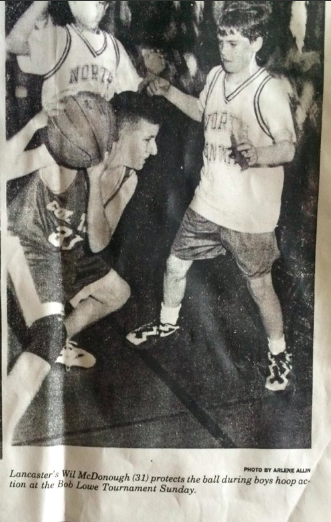
The result of these days was that I became a pretty good teammate and I began to love the game of basketball. I eventually made a 5/6 travel team as a 5th grader, sprained my ankle in the first game and rode the bench for most of the season. I learned how much I loved playing. The next year I got a chance to start and our team played a ridiculous 28 games, winning 27 of them. I can hardly take any credit, though my best game came in our one loss to Lisbon (NH). I scored 14 points. Normally (as in, nearly every game) I would score 4. I was the epitome of a role player. I didn't make many mistakes. I listened to my coaches, supported my teammates, and I played hard (I like to think of the image below as a testament of my sixth grade ferocity).


During my 4th grade year we had had the chance to house sit for some neighbors who had PrimeStar which meant I could watch an NBA basketball game for the first time. The game I happened to see was between the Orlando Magic and the Phoenix Suns. I taped the game and re-watched it innumerable times. The Magic won handily riding Shaquille O'Neal and Penny Hardaway to 60 points. Most impressive for me, though, was a rookie named Michael Finley on the Suns. 

Image result for michael finley rookie card
Phoenix was without their best player, Charles Barkley, and the rookie Finley was getting the start. He ended up scoring 18 points and leading the team. He was number 4 (my birthday was 4/4/84 and I would always try to choose jersey numbers that were somehow derived from the number: 4, 40, 44, 31 (3+1)) and had gone to Wisconsin (my mom went to UW-Stout and I had mistakenly thought that meant she'd been at Madison and rooted for the Badgers)...but most importantly, he was new to the NBA and the idea of a ROOKIE had never occurred to me. As a 4th grader, I too was new to basketball and though Michael Finley is like me...I'm a rookie. I'm figuring it out...it's all new.

To this day, Michael Finley is always my answer to the question, "who is your favorite basketball player?" and I love knowing the story. He was my first ROOKIE, my first connection to someone to whom I could relate and I loved his game as an athletic shooting/slashing 6'7" wing player. But it was his connection to my own experience that I loved. When he won a championship during my senior year of college, I rooted hard for him. By then I was a Celtics fan, but Finley remained the object of my NBA fascination and love. He signed a contract with my beloved Celtics in 2009 and played with them in the NBA finals, losing to the Lakers. In the middle of his career, he did average 20 points per game for five straight years and was named to a couple All-Star games. He scored over 17,000 points in his 16 year NBA career.

By the time he ended up on my team, he wasn't a rookie any more. He was a seasoned pro, but the next phase of his career (that of a movie producer of great films like The Butler) was awaiting. It was time to be a rookie again.

Image result for michael finley celtics

My basketball career lasted through high school. I was rarely the high scorer, rebounder, or assist-tosser on my teams. I was often, though not always, the captain.  I earned four technical fouls in my high school career. If there was one thing I was, though, I was loyal. Kind of like my affinity for that rookie I watched one night on the Phoenix Suns.

I wonder how many people out there have Michael Finley atop their Mount Rushmore of NBA stars? 

So what does Michael Finley have to do with my job as a teacher?

I love rookies and I think of my students as just that. They are 8th graders and in so many ways, this is their first foray into being small adults. They are on the brink of High School and THEY ARE READY. I love rooting for rookies and seeing them exceed expectations. I am proud of them already for whatever it is they become. They remind me that I, too, am new at so many things. And I love that. I love being reminded of all the ways I, too, am a rookie, still tossing a ball against Mr. Judson's chalk-drawn hoop on the playground and being a student of the game.