When Will McDonough was a little boy, he loved to learn. In fact, he still does. Will is a teacher now, and every Thursday he writes about something he's learning in the classroom. He's pretty busy, so he takes just 30 minutes to free write; then, regardless of how polished the ideas or mechanics might be, he publishes it. It's incomplete. It's a start. And it feels good.
Thursday, January 30, 2020
Space in the family of things
Sometimes I get jealous of birds who, as they soar, have so many directions from which to choose.
I like to run in the woods for this reason. I love the feeling of having endless trails and wooded paths to blaze down; I love the opportunities to fly over roots and around rocks--the nuances and variability is just endless and beautifully poetic. The rhythm one of improvisation and movement, momentum and balance, all of it a beautiful dance.
I suppose that's why I hate the treadmill.
All of it, though, corresponds to our human relationship with space.
Sometimes, we need space from humans. As Roderick Nash writes in my favorite nonfiction book Wilderness and the American Mind,
"Wilderness appealed to those bored or disgusted with man and his works. It not only offered an escape from society but also was an ideal stage for the romantic individual to exercise the cult that he frequently made of his own soul. The solitude and total freedom of the wilderness created a perfect setting for either melancholy or exultation."
Yet, at other times we need a peaceful, quiet space to be with other humans.
In spheres of learning, like the one I inhabit with my students at the school where I teach, everything is about human beings and the spaces in which we spend time.
Sure, the relationships are most important, but the links between autonomy and collaboration, between support and self-advocacy, are a constant dance of beautiful proportions. Whether academic or social-emotionally, schools are fragile places because at any given moment we--as inhabitants of schools--are required to gauge what those around us need--for themselves and from us.
Mac, a ninth grader at our school, spoke today during his "This I believe" speech about the importance of being outside...of the dueling personalities of wildness and peace in nature. And it has made me think of the ways I hold space for my students, and of the ways that caring for them.
The Rev. angel Kyodo williams (one of two female zen teachers of African descent in history) says, "Love is space. It is developing our own capacity for spaciousness within ourselves to allow others to be as they are."
And this is so much of what we do as educators: we engage in the space between ourselves and our students. We invite them into the sphere of our own experiences and we ask for permission to coax their own realities and identities out of them. Sometimes our students "need space," and other times they need us to fill their space with support and care.
Like birds, there are so many directions to fly. Sure, the rigid rails of the textbooks and curriculum churn forward like a chuffing freight train with a destination and a time table and a conductor managing the decorum and accountability...but the education of humans doesn't actually look like that.
In scripture, Matthew 6:26 reads, "Behold the birds of the sky, that they don't sow, neither do they reap, nor gather into barns; yet your heavenly Father feeds them."
The space between ourselves and our students is fertile. And from that space we harvest moments filled with both melancholy and exultation. But in both, there can be joy.
My students remind me of this daily. For them, on even my worst days, I want to answer the call of Jamie Tworkowski, who calls us to be "a living, breathing, screaming invitation to believe better things."
I realize I have drawn inspiration from a variety of people's words in this post. I will end with more words that are not my own: my favorite poem of this week, "Wild Geese," by Mary Oliver.
May we, as teachers--along with all the teaching and assessing and affirming and guiding--above all else, find space in each day to announce our student's place in the family of things.
Thursday, January 23, 2020
Slowing Down
Earlier this week I watched a video clip from a well known personality in the world of personal development and growth. This celebrity enjoys interviewing experts in a variety of fields, each of whom offers insights to help viewers rethink the systems, patterns, and mindsets that dictate the ways they function and interact with the habitats and people around them.
I enjoy gleaning insights from these talks, and I often find application to the relationships I cultivate in my classroom.
This week, I listened as an expert professed that "the worst exchange we can make as professionals is trading our time for money."
I understand that if we can create systems that allow our money to grow without our daily engagement or manipulation (i.e. "passive income" or "compounding income"), our money grows more quickly.
But when it comes to impact...when it comes to the exchanges that have value, I just don't see it.
Sure, I could create programs and systems that enable my work as a classroom teacher to be conducted in the absence of my instruction, conversation, or connection with them. I could build apps for other teachers and sell my lesson plans online and engage in all those entrepreneurial pursuits...and I might do that. In fact, I think about it often.
But the reality is, when I think about my decision to be a teacher, shortcuts and growth just can't be fabricated. The currency in a classroom is in the relationship. And relationships take time.
Without connections, something would be missing.
Education isn't about what we do. It's about how we do things. How we spend our time.
Our shared days in the classroom are finite, and yet we have the opportunity to be with one another in these moments. Our time is our currency, because nothing is of greater value.
This week, as many of the students in my classroom were out sick, we happened upon a really wonderful project that takes time. My students are creating maps of Africa and looking for correlations between them. My hope is that they will struggle to see ways that their research and collections of data align with one another; but sometimes they won't. Sometimes the investments of time they make will be distinguished by the lack of correlation...by the thing they fail to see come to fruition. I want to leave them enough time to be okay with that...to appreciate the journey.
They are trading time for something that might not fill their bank account...that might not compound. That might not yield a 100% when it comes to conventional measurements of "winning" or "victory."
But I love spending time with my students as they collect data, as they pore over spreadsheets and graph ideas. I love seeing their colored pencils emerge as they draw maps and we play music from the ancient Malinke empire of west Africa.
We are spending time slowly, together, letting the process guide us. Some of the maps aren't particularly good when it comes to coloring within the lines and employing key-related conventions of color and cohesion, but none of that matters. The project is about spending time well. It is about forgetting where we are and letting the final product emerge without the stress of a looming deadline. Sure, it needs to be finished, but instead of having a quick deadline, I decided this year to extend the deadline and invite students who finished their maps earlier to look up supporting images, draw a third map, find a current event that linked to their inquiry, or do something else that is rich and immersive in guiding the ways they're growing.
So, that's what I've learned, that's where I am.
Slowing down and holding space for the directions and inspirations of my students.
Thursday, January 16, 2020
Taking a Risk (my first 10 minute vlog post)
This week I didn't have time to write for thirty minutes, so I thought about how I could hack the medium of my weekly reflection. I didn't have thirty minutes, but I DID have ten minutes to talk to myself about what I learned this week.
So, here I am taking a risk at 3:00 on a tired Thursday afternoon in my first ever Thursday 30 Vlog Post.
Thursday, January 9, 2020
Howard Gardner and compounding grains of sand.
If I'm being honest, I often find myself questioning my impact. I wonder whether I'm doing enough, whether I could be doing something more, becoming something more, striving for bigger, greater things.
When I feel lost, the phrase I speak aloud most is, "I just don't know what I'm supposed to be doing."
And today, I thought about impact and about the ways impact is felt and experienced by those around us.
Today in World Cultures class, my students learned about "dumb barter," a method of silent trade employed in the west African Malinke Empire up until about 600 years ago. Instead of having my students take notes and study the activity, though, I had them act it out.
One group of students was the gold-mining Wangara; another were the salt-bearing Berbers; and a third group were the Malinke, an ethnolinguistic group who lived along the Niger and Senegal Rivers.
Because the three groups shared no common language, they relied on drum beats to indicate trade practices, with the drums echoing up and down the river.
So, as my 8th grade students pounded on tables, their classmates navigated a sea of chairs to find their way "up river" to engage in silent trade.
----------------------
During morning advisory a group of students was found "studying" for geography by putting together a collection of map puzzles I have in my room.
----------------------
Meanwhile, later in the day, during English class, my students were invited to explore the nature and organization of a sestina, a poem with six stanzas of six lines and a final triplet, all stanzas having the same six words at the line-ends in six different sequences that follow a fixed pattern.
They employed the sestina format in constructing chapter summaries of Chimamanda Adichie's novel, Purple Hibiscus. What, they asked themselves, should their six words be? Which words provide poetic richness while also providing textual legitimacy to Adichie's advancement of plot and theme?
----------------------
So, what then is the point?
Ah, the point.
Well, the point relates to our impact and the way that our influence is compounded.
So, before I get to the point, a brief comment about compounding.
Imagine you are given a grain of sand on the day you are born. On each birthday, that grain of sand is doubled. On your third birthday you have four grains of sand, and on your fourth birthday you have eight, and so on. Well, by your 65th birthday, do you know how much sand you'll have?
All of it.
Like, literally all of it. You would have the Sahara, the Atacama, the Australian outback, the Thar, th Kalahari, the Mojave, all the beaches.
You would have all the sand in the world.
So, back to the point.
Yesterday I was inspired by a colleague who reminded me of the importance of Howard Gardner and providing opportunities to assess students and inspire students through novel means of engagement.
This colleague compounded that reality by sharing the insight with a group of upper school colleagues.
Now, I have further compounded the impact of connecting multiple intelligence to my students by engaging them in acting and poetry, both creative expressions that are divergent from historic forms of assessment.
Don't get me wrong, neither of these tools was particularly unique or inspired...both were simple. Yet, at the very same time they both opened a door for students to walk through. Will I see my impact? Probably not. After all, all I did was hand each of my students a grain of sand.
But I can fall asleep knowing that when they left my class, my students were given a grain of sand. And tomorrow? Tomorrow, they just might wake to find those very grains have doubled overnight.
Thursday, December 19, 2019
Experiences
I am always looking for new experiences for my students. In fact, I feel experiences are the ways that one's education is defined. As educators, we shouldn't be asking
"What should my students know before they leave my class?"
Rather, we should be asking,
"What should my students experience before they leave my class?"
Experiences impact us and we learn from them, but all learning and knowledge is not experiential. And it should be.
--------------------------------------------------------------------------------------------------------------------------
My students recently finished Lord of the Flies and as they embarked on the writing of essays about famous philosophies on human nature and epistemological thinking, I wanted to have them experience something about the various ways that power and corruption and relationships can become intertwined.
Here's what transpired.
I placed, in the center of the room, a bowl of chocolates.
I handed each of my 17 students a marker.
I told them we would play a game. I would tell them how many chocolates were in the bowl. Without speaking to one another, they would write the number of chocolates they wanted to have on their desk (whiteboard markers are awesome). As long as the total number of chocolates written on their desks didn't exceed the number of chocolates in the bowl, they would get the number they'd written. However, if the added number of requested candies exceeded the number in the bowl, nobody would get any.
The first round there were 16 chocolates.
The second round there were 9 chocolates.
The third round there were 9 chocolates, but students had to give their chocolate(s) to someone else.
The fourth round students voted for two people who would decide how the 17 chocolates would be divided.
The fifth round saw one student's name chosen at random; that student was the RULER who could decide how the 17 chocolates were distributed.
The sixth--and final--round invited students to discuss and vote on how the chocolates should be distributed.
(Then, of course, when we were done I made sure everyone had the number of chocolates they wanted)
It was fascinating and I am sure you can imagine how different groups of 8th graders responded.
They experienced something. They felt things. They learned stuff.
I bet they won't forget it.
Friday, December 6, 2019
Submerged in the sunrise of wonder
“At the back of our brains, so to speak, there was a forgotten blaze or burst of astonishment at our own existence. The object of the artistic and spiritual life was to dig for this submerged sunrise of wonder.”
-G.K. Chesterton
I think G.K. Chesterton would have made a terrific teacher...or at least he would have centered his educational experience around a pedagogy that possessed great value; the very object of education, after all, should be to dig for this submerged sunrise of wonder.
Shouldn't it?
I wonder, then, whether our spiritual and artistic selves--however we identify them--might actually be closely tied to our own identities as learners, too. I've always appreciated the word "learner" more than "student" because, while we're always learning, we don't always identify ourselves as "students."
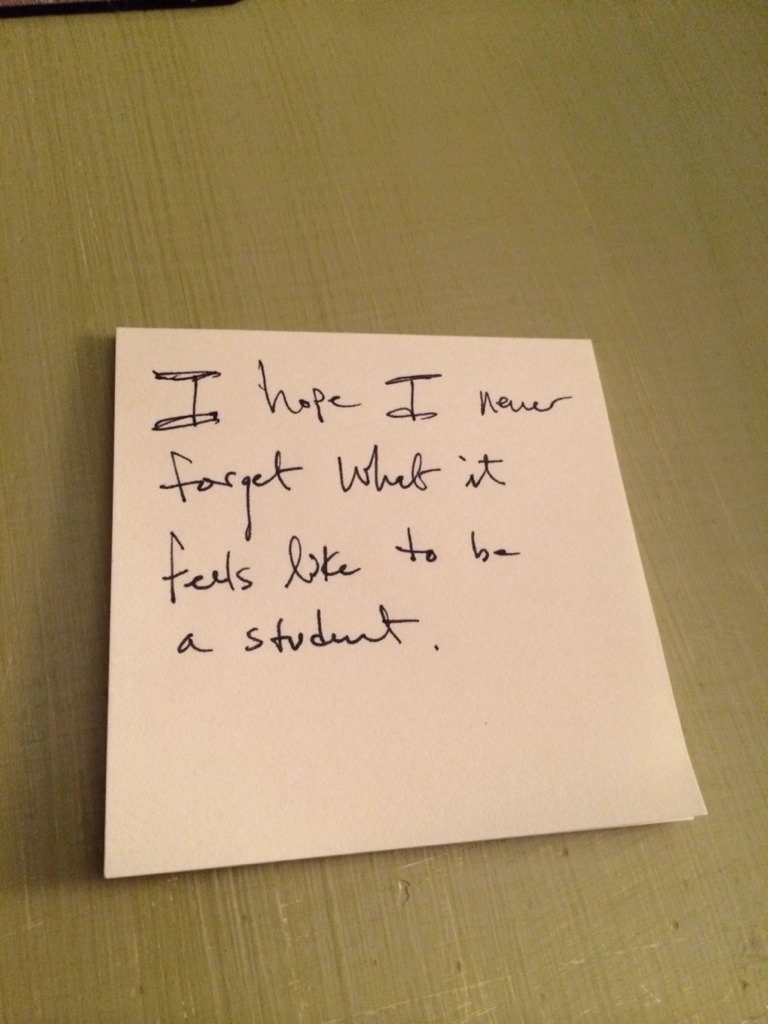
For years, I had this Post-It note sitting on my desk:
This served as both my reminder to retain empathy for my students, while also ensuring that I didn't forget to be a learner, fueled by curiosity and an absolute sense of wonder at the "burst of astonishment" in my own mind.
Right now, my students are embarking on the "WHOA" Project, an assignment I created to invite them to study something that made them say Whoa!, but that we wouldn't be studying in world cultures this year. It's also an acronym for Worldly Histories, Oddities, & Anthropology. But the root of what I love about these two weeks of exploration is the chance I get to come alongside my students as research assistants. No matter what they are studying, I get to be just as curious and inspired as they are.
I feed off their energy.
I research with them the relationship to feet in various cultures.
...or the origins and interpretations of Santa Claus around the world... or the varying ways that children are named.
Side-by-side, I question the cultural appropriation of EPCOT's World Showcase with a student, and I listen to the stories of Argentinian corruption that another student learned from their parents the night before.
It is a magical ride, and all I've done is open a door.
And it is this that I love about middle school, about my students who are so fully children and so fully emerging into adulthood. They are fascinated and scholarly.
Their brains are awake. They are alive.
They are submerged in the sunrise of wonder.
Thursday, November 21, 2019
Employers of Words
My students are holding an essay in their hands.
They pore over it and mark, in pen, the elements they like, as well as recommendations for improvement.
As they discuss the piece, they realize each of them only had an incomplete portion of the piece of writing. Thus, they are forced to engage with one another.
"Wait, do you have page one? What was the thesis?"
"Who has the last page? Did they come back to that initial anecdote?"
"What was the author getting at here in this block quote? Do they analyze it on the next page?"
Overall, they enjoy the essay, but it is different from the literature they generally engage with in eighth grade, because the essay they are reading was written by an eighth grader.
We rarely share writing with one another as adults, but what better way to learn to write than by reading assignments of others who have done the same, and who shared our goals? What does a great thank you letter look like? What about an email? A cover letter? An apology? Words matter so much, but we seldom see things outside of formal writing in books and periodicals.
The one wrinkle here is that this isn't peer editing because the essay they're reading was written by one of my former students...someone who sat in their seats years ago.
See, that is one of the beauties of teaching. While I get wiser each year (hopefully), my students are always eighth graders. I love that and I love hearing them refer to my former anonymous student as "the author."
------------------------------
I received an email from the parent of a former student this week. The student is now in college and had written a piece for their school's literature magazine about rape culture and the responsibility of colleges. The piece was beautifully written and--as a result of the troubling topic and the student's strength as a writer--very difficult to read. It was hard to read something so raw and painful from someone I had only known as a 14 year old.
But, I supposed that's what happens. Children become adults.
It made me think about where my students end up as writers. Perhaps they become authors or publish articles in their college newspapers.
Perhaps they don't.
Maybe they grow to write a poignant and meaningful thank you note, or a cover letter that takes a future employer's breath away. Maybe they just leave a note on the kitchen counter for a future spouse that keeps their relationship intact or heals a moment of miscommunication with a friend.
What I felt as I read my former student's writing, and as I watched my current students read the work of someone who is off in the world writing something different and new, was the gravity of our words.
Our words matter and when we date our work and save it, we leave a trail of insights and development around the ways we interact with the world.
What we write today becomes tomorrow's history, but it's also capable of influencing the present audience that experiences it, and it serves as a stepping stone for our futures as writers and employers of words.
Thursday, November 7, 2019
Human Beings vs Human Doings
I was speaking to a student recently about time management. I laid out some strategies and recommendations about how he could prioritize those elements of his life that were both urgent and important. I was beginning to discuss the notion of "triage" when he cut me off,
"Mr. McDonough, wrestling season is starting soon. I'll have practice every day. I will be fine. I'll be so busy I won't have time to procrastinate."
I was shocked, but not surprised. Of course my student felt this because it's the way we have to be. When we are slogged with responsibility, weighted down by the burden of it all, we just we don't have a choice.
This week was that way for me. My wife was away at a conference and every night existed with a HUGE responsibility, but also sandwiched in between was so much joy. My responsibilities are rich with life and entrenched in the experience of being human.
Yet still, when someone close to me recently said, "Will, you aren't a human being right now, you are a human doing." I realized they were right. And through realizing this I can empathize in meaningful ways with my students.
I need to remember, as Thich Nhat Hanh writes, "I am here to be here."
Human being, not human doing.
Friday, November 1, 2019
Orange Cones & Picture Frames
I place an orange cone on a desk and ask my students to describe the object.
What is this?
What is its primary function?
Next, I place an empty picture frame.
Again, I ask
What is this?
What is its primary function?
The answers range, but generally they land on
A traffic cone is used for identifying hazards.
A picture frame is used to identify things that are noteworthy.
I then asked my 9th graders to consider which object they use metaphorically in their lives on a regular basis.
Do they highlight the anxiety-inducing hazards, or emphasize the noteworthy beauties and accomplishments of their days?
They all agreed that the tests, failures, and faux pas tend to overwhelm their days with orange cones and caution tape.
The small victories and nice moments? They hardly notice them.
We then discussed how one job of a leader is to look for opportunity and inspiration in the everyday and the mundane. Leaders need to shift an organization or team's focus onto areas for growth and development. They need to look at things that are easy to address and that are important...things that shift culture, that create norms and traditions, and that reinforce values.
So what did my brilliant students do next?
We took a field trip around campus to hold the frames up and identify everyday moments of inspiration, opportunities for joy, or ideas for how or where we could draw our communal attention to invite a manifestation of GOOD to overtake our campus.
I was happy.
I was inspired.
I was, as always, following my students.
Let's focus more on framing the good instead of cautioning against the danger in our lives this week.
After all, schools should be places where student leaders are constantly seeking places to grow and evolve the culture...not places where anxiety and orange cones become the culture.
Thursday, October 24, 2019
Self Care is Brave
There are so many things I could have written about this week. So many good and beautiful things.
But I didn't.
I said "No."
I went outside and sat in the sun for thirty minutes instead.
I closed my eyes and I breathed.
It's what I needed.
Today, that was enough.
#selfcareisbrave
#IamEnough
But I didn't.
I said "No."
I went outside and sat in the sun for thirty minutes instead.
I closed my eyes and I breathed.
It's what I needed.
Today, that was enough.
#selfcareisbrave
#IamEnough
Thursday, October 17, 2019
Swiss Army knife thinking
This week I spent a great deal of time alongside my students as they studied the geography of South Asia, and simultaneously collaborated on a group project (their task was to create a board game proposal that included some link to Hinduism).
On both activities, many students expressed their curiosity (and, yes, their skepticism) about my rationale for the assignments.
"Mr. McDonough, if we can search any of these places [rivers, countries, cities, mountain ranges, etc.] on Google Maps, why do we need to memorize them?"
or
"Can we please not work in a group? We are not collaborating AT ALL. I need a different group."
See, I didn't see these questions as a threat, or as an inappropriate questioning of my authority, or an insubordination of any kind whatsoever. Instead, I loved the questions. I leaned into them. They meant that my students were doing exactly what I wish for them to do...they were challenging the status quo and they were seeking clarity. They were questioning and they were being curious about the process of their learning. They were not threatened by what my response might be, and they willingly engaged me in conversation. They trust me.
I knew I had to have an answer. And I do.
So, here's what I said.
Firstly, the reason I have you memorize places in the world is not because I want you to know where they are on a map. Rather, my goals are twofold. One, when you read the news and hear about an earthquake in Kathmandu or a wedding in Mumbai, or an organization cleaning up waste in the Ganges, I want you to have context. Being an engaged cosmopolitan citizen (yes, they know the term) is about having awareness, and when you meet your college roommate and you learn that they are from India, I would love for your next question to be, "oh which state?" or "which part?" or "Oh, is that near Kalimpong?" I want you to be able to see that there are so many things to learn and that knowing even a little bit more increases your cultural capital and allows you to have empathy for the experiences of others; it allows you to engage with human beings in a new and deepened way. If globalization is the "widening, deepening, and speeding up of global interconnectivity," we too must widen and deepen our understandings to keep up with the pace of the world around us.
So, you're right, my student...Google saves time, but awareness about the world connects lives. Cultural capital keeps us curious, but Google just keeps us informed.
And what about those group projects, you ask?
Well, I've been reading David Epstein's new book, Range: why generalists thrive in a specialized world and I've been wildly inspired. I want you to collaborate so you can feel the satisfaction that comes from building something that pushes you to adapt and rethink on the fly. I wanted you to face a deadline and face critics who were invested in the performance as much as you are because they are your partners and teammates. I wanted you to see that there is beauty in the messiness of being finished and admitting "this is good enough....not perfect, but enough for today." I wanted you to toil together. And, yes, my students, I wanted you to struggle. Because the struggle is part of it. And you are learning about yourself as a member of the group, and about the strengths and shortcomings of your own role and identity.
Oh, and I wanted the board game to be fun, and for you to think laterally about the marketing plan and about Hindi and how you might incorporate the language, and about competition, and about the Caste System and the Himalayas and about the landscape of South Asia and the exchange rate of rupees and your own curiosity and brilliance. I wanted you to incorporate as much (or as little) as you possibly could and to be given free rein for your ideas to get BIG. I wanted you to use your abstract thinking skills and I wanted you to see the abstractions in the ideas of your classmates. I wanted to give you many days to problem solve and to rethink your ideas because I love listening to the ways your ideas merge and transform. And I love watching you have time to do things slowly.*
I know you think that you would rather study on your own and take a test at the end because you know what you need to do to solve that equation, and to get a 100%. But the world's problems aren't solved alone. And you don't get 100% on really anything in life. Life just isn't that binary. And YOU aren't binary. And this IS life. Already. Right here. The real world isn't out there waiting for you...it's right here in your hands, and at your feet, and in your lungs, and in your minds.
And we need you to think beyond the tests and the scores and the grades and the isolated studying. Epstein agrees in that book I'm reading, Range. He writes that the current model of education and specialization within academia
"...must change...if students are to capitalize on their unprecedented capacity for abstract thought. They must be taught to think before being taught what to think about. Students come prepared with scientific spectacles, but do not leave carrying a scientific-reasoning Swiss Army knife." -David Epstein, Range: Why Generalists Triumph in a Specialized World (referring specifically to the work of James Flynn).
I want you to think like Swiss Army knives, my students, so you're ready to do anything. I want to watch you transform the world...and that is why I assigned you this work.
And please, never stop asking me why I do.
*these two paragraphs are, coincidentally, exactly the kind of learning environment my son has in his kindergarten class. Kind of beautiful how I am trying to remind my 8th graders to learn like the once did...back when it came so easy.
Thursday, October 10, 2019
This above all...
These were the slides I shared with my 9th grade life skills students on the first day of class this year.
I am teaching them life skills and I genuinely wanted their input...what did they see as the non-negotiable skills they'd need to lead a fulfilling life?
Their responses stunned me.
While each of the three groups of students articulated it differently, they all landed on the reality that one student described as
"Um, I guess it seems like all of our goals [including relationships, offspring, careers, etc.] have to do with how we treat people. Isn't a fulfilling life all connected to the way we are with others?"
This was so simply put, but so beautiful.
Isn't that the case with many things? The simplest ones often end up being the most beautiful.
---------------------
Two weeks later I introduced them to a new exercise. It was about our core values.
The most important person in our relationships with others, I suggested, is the one we have with ourselves.
In Act I, Scene III of Hamlet, Polonius quips,
This above all- to thine own self be true,
And it must follow, as the night the day,Thou canst not then be false to any man.
And so it was that my students embarked on an exercise that invited them to think about the people who had impacted them, and the experiences they'd had losing track of time.
What were you doing?
Who were you with?
When are you your favorite version of yourself?
Next, I asked them to choose from a list of values the values that resonated most deeply with each of them. They chose ten, then reduced that number to the three core values that were most central to their existence.
The results were incredible.
One student spoke about ABUNDANCE.
"Was that even on the list?" a classmate asked.
"Yeah, they're alphabetical. It was first." Then, the student paused. "And can I just say that I don't mean I value abundance as in I want to have the most; instead, it's that I recognize that there is enough already and I just value the fight to ensure that everyone has a piece of the pie."
Another student spoke about CONFRONTATION as a value and their frustration with people who "let me have my way without digging in and debating me about my beliefs and ideas." It reminded me of Steve Jobs' contention that he needed to surround himself with "lions" who would challenge him and question his every move and insight. He realized that he, himself, was a lion, and he needed to be checked to yield the best results.
My student realized this, too.
Another student wrote TRADITION, LOYALTY, HONOR as their three. Their classmates were in awe. They didn't see their classmate this way...but that didn't matter. They understood their values now and it changed the way they treated them.
See, understanding our values isn't just about ourselves. It's also about the people we lead; but it's also about the people we follow--those who inspire us. It's about our families and role models who have led by example, who have passed down their values as well.
And that's where the beauty of discussing values in the classroom comes in. Our school is committed to the partnership between families and the school, and discussing values invites these elements of our shared mission and unified intention: we all desire to help students succeed. Families want this and so do educators. But we also all want our children to grow up to be fulfilled, and to lead meaningful lives.
I only get to be these students' teacher for one year.
My life skills classes meet 22 times this year.
That's less than 24 hours of time.
They get to spend their entire lives with themselves. Their families get to be their families forever. Their parents are always their parents. I will one day be their "former teacher" or their "8th grade teacher."
So what is the impact of a conversation about values?
Well, I don't know whether we can definitively say what the impact is right now. We might need to wait until my students are 40.
What I do know is this: during parents' night for my kindergartener last week, the teacher indicated that there are two goals for every kindergartner. They hope that by first grade each child will have a friend (and know how to make more), and they will understand themselves (as people and learners).
Those are big goals for a 5 year-old, but they're beautiful goals. They're goals that we can partner with as parents...and they're goals I would love to have for my own students as well.
And making friends and knowing oneself? Maybe those are the things we need to learn this year.
The world needs more friends and more self awareness, too.
You know what else the world needs, though?
My ninth grade students.
Thursday, October 3, 2019
Musing
One of the websites I visit most frequently is etymonline.com, a website devoted to the origins of words. You see, I love words. I cherish them. I think they are brilliant in the ways they can make us feel things, and I think they are beautiful in the ways they sometimes fail to articulate the things we feel.
As Mark Twain once famously quipped, "The difference between the right word and the almost right word is the difference between the lightning and the lightning bug."
Words can be that big (and, truth be told, even those subtle fireflies are my favorite animal).
Today I found myself curious about the word muse and its origin.
The word muse (and Muse, for that matter) is of particular interest to me this year because in many ways this year has felt different than any other. I have changed classrooms, transformed much of my curriculum, and I am doing more than I've ever done. I am a hustling whirlwind of activity on many days, and I am often stressed, anxious, and very much not well.
But I am also more consistently at peace, more aligned with my needs, patient with my faults, and generally fulfilled.
The moments of insecurity and self doubt still come, but in those moments I invite my own weakness and meet it. There is a running adage that goes,
"You can let pain sit in the front seat, but don't EVER let it change the music."
The suggestion here is that during the course of a running race we will feel pain. And when the pain arrives we can invite it in. Welcome it.
"Hi pain, I was wondering when you'd get here."
But what we can't do is allow pain to become the definitive tone...we can't change our difficult moments, but we can change how we respond to them. My grandmother, Ros McDonough, once wrote, "Just to show our weakness, the storm comes."
Which brings me to my Muse. My inspiration. The heart of my entire creative existence.
When I met Nicole Chenell, the woman who (SPOILER ALERT!) would 13 months later become my partner and spouse, I was amazed by the way she challenged me. She inspired me, yes, but her inspiration came in the form and flavor of forcing me to think differently about the world...and about everything in it. She linked ideas, dug into difficult topics, and listened so brilliantly to better understand the world and people around her.
So, yes, eleven years later Nicole remains my Muse and my favorite musing partner.
But here is the way she has inspired me in the classroom: she has forced me to think about myself first. She has encouraged and questioned my motives, my outlook, my values, my dreams, and the lens through which I see the world.
This ability has always been there. It's part of her essence, her innsaei. We often have joked that she is the "good listener" of our neighborhood, or the "world's therapist" because of the ways people open up to her (always embracing a depth and vulnerability that stretches beyond the familiarity of their relationship with her) at the park, the bus stop, while walking the dog.
But recently, Nicole has also taken some risks in a new direction. She has founded a life coaching business. And the growth and vulnerability she, herself, has displayed in reinventing herself has inspired my own creativity and my own vision for what's possible in my classroom and my life.
Her website, her Instagram profile...it's all the stuff of brilliant genius. It is helpful and hopeful and beautifully observant. It is a call to action and a treasure just waiting to be found.
And it reminds me of my students. The world--and their crashing course through it--is ready for them and their brilliant ideas. They are in their infancy, but their thoughts and questions are real...they are big...and nobody else has their ideas. Nicole, my Muse, has been home with our kids for nine years and now she is breaking out of her chrysalis, spreading her wings, and letting the breeze float her to the next just right thing...always moving, always musing, waiting for the next idea to pollinate and spread. Just like my students, those students of the world who bring magic to my classroom each day.
And I suppose that's where I actually fall in love with the etymology of muse again. The moment when I read "to loiter, waste time" a smile broke across my face. Daydreaming is part of being creative. Nicole taught me that. Butterflies don't know which flower needs pollinating, they let the breeze float them to the next right flower for that moment.
And that's what musing--and Muses--do, they invite the big magic into our next great idea.
Friday, September 27, 2019
wonderfully dangerous
I introduced my students to an app called "The Most Dangerous Writing App" this week. Now, I don't know why it's called that, but I used it for five minutes and produced the following piece of writing:
--------------------------------------------------------
What Preston shared with me was an application called "The Most Dangerous Writing App." The app erases everything you've written if you stop writing for five seconds.
Like, the words you've written are completely gone. Forever.
So I introduced my eighth graders to this idea. I invited them to answer one of three writing prompts, and the only goal was to not stop writing. The three prompts were creative and relatively open-ended. They included
1) you are an astronaut. Describe your perfect day.
2) what can happen in a second?
3) A houseplant is dying. Tell it why it needs to live.
Their assignment was just to keep writing, to not stop writing...to churn out ideas and a direction for their words and their thinking.
For so many students this caused immediate anxiety, but it also helped them realize what a beneficial tool this could be.
Fear can be a motivator, but so too can the challenge of competition. If a student is able to stay on task for five quick minutes, what can't they do?
If they KNOW their work will be erased, they won't be interrupted by things like the internet, text messages, a desire to run to the fridge and grab a snack...no, instead they will just write like their hair is on fire.
The sound right now as I write this is electric. Deep exhales and inhales married to the clickity-clack of typing on their laptops.
Nobody is stopping, I'm not sure anyone is even breathing. But we are all writing...and as I write this on my own computer, I'm a little scared but I'm also a little excited and empowered. What if I used this every day and just got in the practice of letting my words flow, my ideas snap onto the page with an immediate urgency...
What if all my ideas made their way to the page.
What if I learned to sustain a task and work with no interruptions.
What if this was the most dangerous writing app, not because it will destroy us but because we will all turn into Alexander Hamiltons .
"Why do you write like you're running out of time..."
And the chorus chimes, "That man is...NONSTOP."
--------------------------------------------------------
This experience of writing beside my students in this manner was inspiring. It was compelling. It was addictive. I always write when my students write, but this felt different. It felt like I was writing like a man on fire (just like I'd hoped my students would be). So, perhaps that's why it's called "the most dangerous," because danger can also mean wild, it can also mean untamed.
When we face danger we are vulnerable.
When we take risks, we are in danger.
Ands when we write, we invite vulnerability.
When we write we take risks.
And when an app invites you to take risks without thinking, our inhibitions shut off and we begin to write things and feel things we didn't know we were feeling.
And that can be wonderfully dangerous to shifting the core of the status quo.
Thursday, September 19, 2019
Expectations
Every fall I have the opportunity to fall in love with school again.
I suppose it's become sort of an expectation of mine.
I have always loved school, but I have also always loved the feeling of falling in love with something. It's that newness--that feeling of everything being a "first time" and a shocking delight. When we fall in love we float, we daydream, we imagine what might become.
With a school year I still feel that way. The rebirth of possibility and ideas and relationships. Even the air seems to buzz with a coolly snapping crispness.
During these first weeks of school I like to articulate the expectations I have of my students. None of them have to do with performance, but all of them have to do with the relationship I'm developing with them. Things like honesty and communication and avoiding chronic tardiness are topics we discuss often.
But I also love that my students arrive with expectations of me. I love that they come in thinking they know what English class will feel like or how they will receive feedback.
And then I love surprising them. And I love being surprised by them.
Yesterday I slipped a student a handwritten note acknowledging their contributions to discussion and sharing how excited I was to teach them this year.
Later, the student returned.
"Mr. McDonough, I didn't expect that. Thank you so much for writing those words. It really means a lot. I am excited for the year."
I smiled, took the student's extended hand and replied,
"I didn't expect you to come back to thank me. Thank you."
May this be a year of exceeding the expectations--however lofty--others have for us, and of communicating deeply and meaningfully in ways that make people float, daydream, and imagine what might become.
Thursday, September 5, 2019
Bandwidth
I don't know if I am going to continue this blog.
Writing those words feels good.
It feels cathartic. Real.
Sometimes just acknowledging my own indecision can help me to find the ground beneath my feet. From there I can better identify where I am...where I'm going to ultimately land.
And right now, I don't know where that is.
The new school year is stretched before me and I am excited--probably as excited as I've ever been. And you should know that I have always been excited about school starting. Even when I was a little kid; yet this year feels particularly electric.
I've moved to a new classroom.
I have big ideas...ideas that have grown and evolved over the summer.
I have excited students and I've met many of their parents who are excited for them.
I'm teaching a new course.
I am eager to be led by inspiring new leaders.
I am tutoring some really wonderful students.
In so many ways I am doing so much--so much that I love.
And, still, I am worried. I am worried about my bandwidth and about whether or not I can handle it all.
So I might not. I might elect to give something up, and it might be this blog.
But for today it has felt good to write this. I write as my students write. They are writing about what their life will look like twenty years from now if they've had a fulfilling life.
My life, 20 years removed from eighth grade, is one of inspiration. I feel grounded. I am here. I know where I am, even if I don't know where I will ultimately land. For today, that is fulfilling. For today--the second day of school--that is enough.
Thursday, June 6, 2019
arrivals & departures

It is the end of the school year.
In fact, next week at this time we will have held our closing exercises and the class of 2019 will be on the brink of whatever comes next. Yet those graduating students are not alone in their new adventures; for each student experiences a moving up and a moving on.
It is a time of arrival.
And it is a time of departure.
I wrote earlier this year that many things can be true at once, and this echoes through my heart at this time of year.
I am reading a book by Thich Nhat Hanh entitled Work: How to find joy and meaning in each hour of the day in which the author describes the nature of mindful walking. He writes,
"Bring your full attention to the contact between your foot and the ground. Breathing in, you make one step with your left foot. You can say to yourself: "I have arrived." This is not a declaration; this is a practice. You have to really arrive. "Arrive where?" you may ask. Arrive in the here and now. According to this teaching and practice, life is only available in the here and now. The past has already gone. The future is not yet here. There is only one moment when you can be truly alive, and that is the present moment. When you breathe out, you make another step with your right foot and say, "I am home." My true home is not in the past, not in the future. My true home is life itself--it is in the here and now. I have arrived at my true home; I feel at ease in my true home. I don't need to run anymore."
Perhaps, like the Zeno's paradox of the arrow (in which he questions whether an arrow in flight actually exists because it is either moving into, or out of, a space and, therefore, is never actually in a place because you can't pause it's movement to identify its location) Thich Nhat Hanh is onto something compelling, something that can tether us to the relationship between ourselves and the earth, between time and place, between what's just been and what will be.
I am leaning into the arrivals and the departures of the school year, of summer, of my relationships with my incredible students. I am aware of the departure of beloved friends and colleagues and of the loss of innocence, of feelings of security and feelings of vulnerability.
In all of it, though, I am going to resist the urge to speed up.
Instead, I slow my cadence and whisper, even in the departing.
"I have arrived.
I am home."
We cannot change our circumstances, we can only choose the role we play in the moment we're living.
Thursday, May 30, 2019
Here to be here
I really enjoy reading, but the book I've been reading this week has been particularly touching. You see, my mother shared this collection of essays, a word from the field, that her friend Brendan compiled a few years ago. I was drawn to Brendan's words because, firstly, they were beautiful reflections on adventure, life, art, self-exploration, and the thin line between nature and humanity.
There were three moments, however, that struck me most deeply. The first was the following passage.
Like Brendan, I too am still much the same kid I was twenty years ago though I often fear I've changed. Like him I am excited by beauty and a little too easily hurt by the world. I still need to be cared for and, yes, I am still searching for poetry in daily life.
It made me happy to read Brendan's words and to know that others reflect in the ways I do. We grow and we stay the same. We take baby steps forward, we shed our skin, our hair changes, our joints grow creaky...but at the end of the day, we are still the little children we once were if we allow ourselves to be.
I was also touched by the words he shared from Peter Matthiessen:
"I am here to be here."
I shared these words with my students today as we prepared together for their final exam in my world cultures course. "What," I asked them, "would a Taoist say about this line?" "How about a Buddhist?" "And a Confucian scholar?"
In essence, I wanted them to prepare for the exam by looking through the lens of this statement...by asking "Why are we here?" because that's what belief is...and it is so central to the ways we build culture.
Culture answers the question, Why are we here?
I also encouraged my students to read these lines as they prepare for their English exam...which characters about whom we've read this year would identify with these words? Who stays the same? Who changes? Who, over the course of the novels we've read, transforms and loses themselves? Who finds themselves?
Everything can be an opportunity to think deeply about what we are learning. Everything is a lens into our minds. Everything is connected. And when my students ask "Does this matter?" during an exam review session, I always say, "It all matters! Yes!" then I add, "but it won't necessarily help you get an A."
In his next essay I was reminded that I am here. Teaching at my school. Learning alongside my students. Befriending so many in this community. We have boarded a ship together and we are tacking for the horizon, whatever it may bring.
These are uncertain times. But I am certain that our ability to cling together will sustain us, whatever the storm may be.
On a deeply personal level, this notion of "sister ships," those "parallel lives" we didn't chose, but that have still left a mark on us resonated with me.
I reflect often on decisions I've made and circumstances in which I've found myself. I daydream sometimes about what might have been. Not because I wish for a different outcome, but simply because I am a dreamer and I wonder where those ghost ships are and who may have taken my place at the helm of that story.
Brendan wrote these words as he navigated Escalante, one of my favorite places in Southern Utah. I happened to have walked the same steps he walked as he wrote about these "sister ships." I even slept beneath the same outcropping of rock he described, gazing up at a ribbon of stars and the ancient petroglyphs on the wall of stone behind me. I walked and slept among these magnificent rock canyons of Death Hollow with my father just before I moved to Connecticut in 2008 to take the job I now love. That hike was my swan song to southern Utah...that ship sailed off in another direction. But the beauty was that my father had also left Utah when he, too, was in his twenties. He embarked on a new adventure, one that included my arrival to the world.
There's something magic about space and time. I am aware of that with a week to go until my students are no longer my students, off on their own ships, navigating new seas.
And here I am. Here to be here. Glad to be aboard this ship, churning slowly forward alongside these shipmates, ready to face the mysteries of the deep. Here to be here.
Subscribe to:
Posts (Atom)