Friday, March 8, 2019

Living Laterally

This week I found joy in reading my students' writing. They had written incredible, poignant, scholarly works on some of the biggest problems facing the world today. They discussed the causes of these issues and they investigated solutions. They showed optimism and they were unwavering in their individual calls to action.

I couldn't have been more impressed.

At least, that is until today. Today they handed in their collections of original poems, each bound and stapled together in a small chapbook for me to read over spring break.

And I was more impressed.

While their World Congress papers were scholarly, brimming with footnotes and evidence of their research, their poems reflected the unspoken stories and songs, joys and pains, of their hearts.

Their World Congress topics had been assigned, but their poetry topics had been discovered deep within the shadowy depths of their own inner selves.


We need to think like that, don't we? We need to be flexible and jump laterally between disciplines, reminding ourselves that there are so many things to love in life and that we have the ability to be eternally curious about what we're capable of doing, creating, and becoming.

One of my earliest mentors was my best friend's grandfather. His name was Harry. I didn't see Harry very often, but whenever I did it felt as though he lit me up with an electricity the likes of which I'd never encountered. He was just so alive and so excited to ask me BIG questions and to engage in BIG adventures.

I recall one time we had dinner at his house. He had made a schematic drawing of a "Big Mac" and told us we were going to be assembling our own Big Macs for dinner. The only problem, he admitted, was that he wasn't sure he'd gotten the "Special Sauce" right, so he needed us to assemble it and see if we could taste test it to get the proportions right. So of we went to the kitchen with jars of mayonnaise, ketchup bottles, sauces, and tinctures, and spoons, and herbs. Ultimately, I think he knew that the sauce was just a variation of 1,000 Island Dressing, but we probably made a half dozen of our own "special sauces" that night. And most importantly, he drew us (young as we were) into his world of fascination with everything and anything...even a Tuesday night dinner in July.

I recently was reminded of Harry and the way he woke up something within me. I searched his name and saw that he'd died in 2016. The Obituary from The Vineyard Gazette (before moving to New Hampshire he'd made his home for 30 years on Martha's Vineyard) follows. It made me smile deeply to know that my memory of Harry aligned with reality. I'd been in elementary school when we made Big Macs in his kitchen, but sometimes the legends and memories of our childhoods--just like my students' poems--put words to truths that simply cannot be said.

...He loved to go to the dump (not the transfer station) and hold court, or to the library where he would take slips from all the exotic plants. (“It’s a win-win, they needed pruning anyway,” he would say.)
He brought his family to [Martha's Vineyard] in the 1960s and told his son and daughter over and over that this was a special place, that they should always remember it, that it wasn’t ordinary, that they were blessed to be here.

He wouldn’t talk about the typical Vineyard attributes that all the world knows about; instead he would talk about the midnight walks he took, insomnia providing him an unexpected gift, from his home on William street, down to the boat wharf, down to Beach Road, meeting those who also couldn’t sleep, returning with many more adventurous tales than his dreams would ever give.

He would talk of cold, foggy, Sunday afternoons at Lucy Vincent, gathering driftwood with his wife and kids, using it to create makeshift dwellings complete with chimneys and Sterno campfires, heating hot chocolate, and hoping there were other brave souls venturing out to the beach on those days, who would see the cozy shelters and wonder who the lucky ones were inside.

He talked of the teen gatherings at the Ryder house, laughter abounding, of waking his children up in the middle of the night to walk William street in the deafening silence of a good Christmas snow.
Starting in the Vineyard school system, then doing whatever possible to keep his family on the Island, he paid the price of being a visionary in all things. He was not always understood or easy to work with — but oh, how he loved the Vineyard.

He especially loved the Island people, the everyday, honest, straightforward open people, and the creative, outside-the-box people.

I hope, when I'm in my eighties that I, too, am seeking out people like this...the everyday, honest, straightforward open people, and the creative, outside-the-box people.
x

Thursday, February 28, 2019

Putting to words

"Sometimes there aren't words.
Sometimes sentences and phrases can't do the moment justice.
Sometimes language fails,
and you're speechless."
(Rob Bell, What We Talk About When We Talk About God, 87)


We are doing poetry in English class this week. Not so much teaching students what it means to read a poem critically, but doing poetry. I am sharing poems with my students. I am asking my students to share poems with me. We are investigating the tone, rhythm, and purpose of the artwork of poets.

But throughout it all, we are trying to understand what it feels like to put words to what can't be said.

Today we looked at Kaveh Akbar. We looked at Naomi Shihab Nye. We looked at Billy Collins. We looked at Nikki Giovanni. We looked at Osama Alomar. We looked at Pablo Neruda. We looked at Mikko Harvey. We looked at each student's own writing, their own exploration of what it means to put words to the impossible feelings and experiences of the world.

But the moment that won the day?

When I found a poem for one specific student. I slid the book over to them and just nodded my head.

And they read the poem. The poem by an unknown Chilean woman. The poem that put words to what can't be said. The poem by a person whose name can never be known.

And the student's response?

"That is the best poem I have ever read."


For today, those words are enough because I know when I see that student tomorrow she will have new words.

Thursday, February 21, 2019

The Appointment


I recently watched the film The Greatest Showman with my children. It was a film they have been asking to watch for a very long time (well, at least since "literally all" their friends had seen it).

So my wife and I watched it first as parents. You know, just to play that "PG" rating by the books for once.

And we were kind of unimpressed. Frankly, we were critical of the lack of character development, the glossing over of elements of plot and depth that we felt could have been so much more masterfully orchestrated. The music was good and we felt it would make for some great talking points as a family.

Then we watched the movie with our kids.

We saw it through their eyes.

Suddenly, the plot was gripping.
The characters were filled with magic and wonder.
The. Movie. Was. Just. So. Good.

But the music...the music was incredible.

I've always dreamt my life could be a musical. I love musicals. I loved being in them, I loved watching them. It wasn't until I watched the film through the eyes of my kids, though, that I really fell in love with it. Just the opening lines to "A Million Dreams," when viewed through the lens of my six year old son were enough to bring me to tears.


"I close my eyes and I can see
The world that's waiting up for me..."


As I write this reflection, I imagine watching my son closing his eyes,
swallowing hard,
and dreaming of a world of possibilities.
A world that is his.

And I know the world will disappoint him, that there will be days and weeks and months and years that feel like his dreams are too big for the world...that they're too wild, too reckless. The world will tell him that what he wants to do is...

is...

impossible.

This week I was hit with a realization. It came in the midst of some personal disappointment and a realignment of the "dreams" I had for myself....dreams that have been deferred. Dreams that, as Langston knew, will someday "explode!"

Here is my realization:

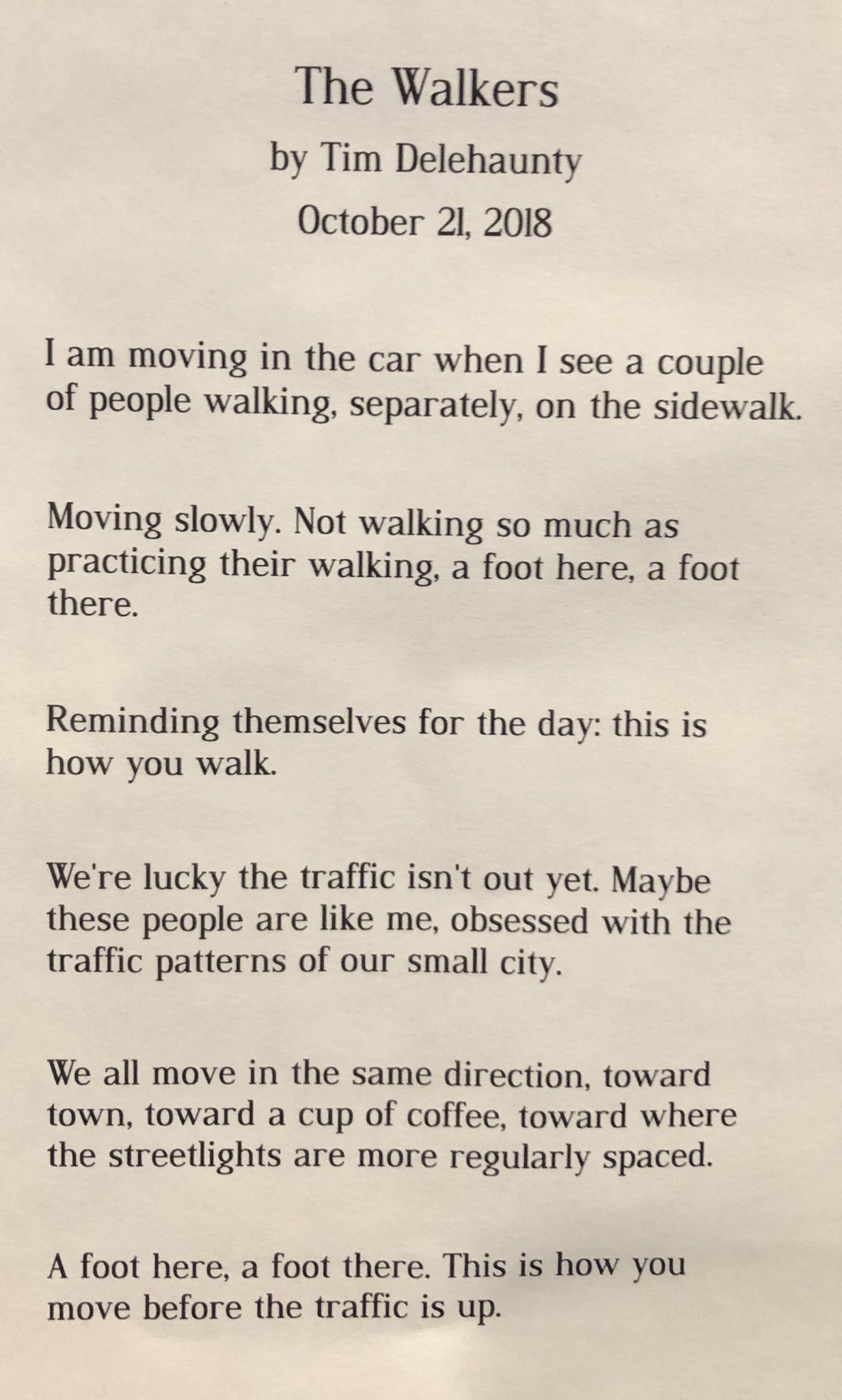
When disappointment strikes, realize that THIS appointment called your life is greater than your disappointment. This is what I am learning this week. Sometimes, in the midst of rush hour, we must be reminded how to walk. I am practicing my walking. “A foot here, a foot there.”

These last words were inspired by one of the final poems my incredible friend and mentor, Tim Delehaunty, wrote before his death this fall.


This week my appointment found me practicing my walking alongside my students as they outlined their World Congress papers. They are developing the foundation for incredible, analytical, insightful papers on some of the biggest problems (and solutions!) facing the world today (and tomorrow!). One of the major sticking points in their visions, though, was the conclusion.


"Mr. McDonough?" one student asked during a writing conference. "I've already written about the future and outlook of my topic...and I even included solutions and ways we can help. What should my conclusion be?"


I smiled and bent my knees. My shoulders shrugged and my hands gripped the air, outstretched as if holding two bricks gently before me. There was a glimmer in my eye...


"Yes!" I whispered excitedly. "That is an incredible question...that's the incredible question you need to be asking...but the only person who can answer it is YOU. This is your opportunity to place yourself into the narrative. This is where you get to speak from right here [as I patted my heart]. This is where you get to design the world you want to live in...tell us how this research has changed YOU and inspire ME, your reader, to think differently about the way I lead my life. Use this conclusion to make every second from this point forward different for me!"

And in that moment, I found my appointment.

It wasn't my forever appointment, it was my appointment for today. It found me in a place"...where no one's been before, but it feels like home."


"A Million Dreams" (from The Greatest Showman)


Thursday, January 31, 2019

Building trust


Sometimes building trust is difficult. Sometimes building trust requires a level of humility and humanity that isn't always easy to access given the pace of our days. Building trust takes vulnerability and it takes the ability to listen. Building trust happens when the important is prioritized over the urgent.

And building trust cannot be rushed. Building trust takes time.

I wonder if, perhaps, that's why we use the verb "building" to talk about trust. When building anything, one must be careful to go about things in the right order. Foundations must be surveyed and established first, and it is not always easy to see immediate progress when building. But for those intimately involved in the process? Progress is always happening, just as the quiet seed is laying roots beneath the surface...progress moves, however slowly, however unseen by the naked eye.

That's kind of like trust.

I have the following image on the notebook I carry with me everywhere. It comes from Patrick Lencioni's book, The Five Dysfunctions of a Team, and it is used to illustrate the hierarchy of dysfunctions.


At the bottom of the pyramid there's ABSENCE OF TRUST. According to Lencioni, in the absence of trust, each of the other four dysfunctions will be evident on a team (and yes, that means any team, all teams). Without trust you'll have a
Fear of conflict; 
Lack of commitment; 
Avoidance of accountability; 
and Inattention to results.

Sounds like a recipe for failure, right?

Well, my classroom is made up of human beings (myself included) who operate as a team and today I had the pleasure of watching my dear friend, Laconia Therrio (our school's artist-in-residence for the month of February) build trust with my students.

He made jokes.
He learned their names.
He asked them where their families are from.
He held space for their questions.
He told them stories that were hard to tell--stories that came from his experience, his heart.

Yet,
he also mispronounced their names.
He told jokes they didn't think were funny.
He embarrassed himself.

(and he does it on purpose)

But in each of those instances, he owned up to it. He showed them that he valued pronouncing their names correctly. He apologized for the bad jokes that landed poorly or whose impact differed from his intention. And he admitted his own insecurities.

By the end of his 50 minutes with my students...they trusted him.

Trust cannot be rushed. It takes time. It might feel like the time is wasted, but I assure you it is not.

My students' trust in me is the only reason they feel comfortable coming to tell me they need an extra day to study because they've been underslept and overwhelmed by the week they've had.

My student's knowledge that I won't shy away from conflict enables them to be committed. Because my expectations are reasonable and I'm willing to listen to their needs, they want to do well in my class and are committed. As a direct result of their commitment, they allow me to hold them accountable and to seek out a higher standard of engagement. And because they embrace accountability, they care about the link between their effort and their results.

They are active participants in their educations because they have relationships.

It starts with that. Kids will run through walls for you if they believe you value the time it takes to build trust.

As much as trust feels like it is an outcome-driven exercise, it is a different type of "building."
Trust is about the product. Things that are built exist, after all. But for trust to be built it must be 100% about the process. And that process takes time.

Thursday, January 24, 2019

Different Brains

Today I asked my students to draw a diagram that illustrated the way they spatially understand the year.

We can all agree that a year measures one trip around the sun.

We can all agree that a year contains 52 weeks, each of which has 7 days.

We can all agree that there are 12 months and that 365.25 days fit into them.

But how we see the year when we picture it in our minds is entirely different.

And this tells us something about our brains. It tells us something about the way we think.

One student explained that they see the boxes of a calendar extending like a number line, beginning in January and ending in December.

Another admitted that they associate each month with an image and an animal (May, for example, is mist and morning doves).

Yet another sees the months like a circle, but September through May appear larger than the other months.

Finally, a student sees each month as its own color!

In all, we had 15 different perspectives, each fascinating and unique.

This got us to a conversation about our minds and the ways that things make sense. Eventually, we found ourselves discussing note-taking. There are hundreds of ways someone can take notes. As a visual learner, I know the impact that writing something down (and revisiting it afterwards) has on my life. I walk around constantly jotting ideas and observations into my notebook and I sometimes find myself stricken with fear by the possibility of not having a notebook or pen when I have an idea or insight.

I know, deep down, that if I don't write it down I will forget it.

I even take notes on family life and relationships with friends. I jot down the names of my friends' kids. I jot down reminders about how to care for each of my kids and my spouse. I want to study them to better understand them...and not in a creepy, weird way, but in an authentic exercise of understanding them better and evolving my ability to love them well.

So today, we discussed what it means to take notes and the ways it can be done.
-full sentences
-pictures or images
-diagrams
-fragments
-bubble charts

The list went on and on...and for each of us, the ways we make sense of external stimuli is different. Some of us need a graphic organizer to make sense of information while others among us need to follow up with the teacher the next day.

The key here, though, was not really about note-taking. Rather, it was about holding space for students to embrace the ways we all learn differently, and the variety of needs each of us has.

We are all learners and we all have specific needs. Talking about our differences and the ways we learn best is a trait that will help each of us to learn better and to hold space for the ways others learn as well.

Thursday, January 17, 2019

In Defense of Art

I'm reading Harry Potter and the Sorcerer's Stone with my 8 year old daughter right now. Each night we make our way through a chapter. One of the conversations she and I have had is around one of the topics that Harry and his classmates take at Hogwarts School of Witchcraft and Wizardry: Defense against the Dark Arts.

Among my daughter's many questions have been, the following:

What is a dark art, anyway?

Why are those arts dark and other arts not dark?

Can't all art be dark and angry and mysterious, after all?

What makes something an art in the first place?

If art is the expression or application of human creative skill and imagination, is there any creation that actually isn't art?

Okay, so that last one wasn't her, but you get the point.

And it got me thinking about art (and my defense of art) and the role it's played in my life. Given who my parents were, I never really identified the activities I engaged in as a child as "art" or "not art." Instead, creativity and beauty and expression were entrenched in everything. Sunsets were art. Clouds were art. My block structures were art. The dams we built in Cummings Brook were art. The bread my dad baked was art. The letters my mom decorated before mailing were art.

Everything was art.

When I graduated from high school, the greatest honor I received was being awarded the Arts and Athletics award. I was so incredibly proud of the risks I'd taken as an artist. In fact, even today I have this poster on the wall of my classroom in an effort to remind my students that art is a language and integral to our discussion of culture.


So this winter I'm doing three really specific art assignments with my students. Two are taking place right now. One is the creation of compelling, thoughtful political cartoons that coincide with the Berlin Conference of 1884; another is a map project that requires each student to create a 2-map atlas plate that displays the correlation between two disparate data sets; and the third is a project about color. That final one is still in its infancy, but essentially, students will be given a color and asked to do some research about the history of that color (I was inspired by The Secret Lives of Color by Kasia St. Clair) and then they'll do a 60 second voiceover describing the brief history and connection to culture while a video shows them creating the color by mixing paints together.

I'm excited for it, and it's gotten me thinking about art and our commitment to it at my school. I ran some numbers and learned that my 8th grade students spend 7.7% of their time in art class. If they are in an Ensemble, that number jumps to 10.6%. One of my goals in the coming year is going to imagine a world where art is immersed more deeply into the fabric of the school day. How can we, as adults, model the creative risk-taking that it takes to be an artist?

Can we create clubs or electives that are connected to art?

  • a Hamilton elective taught by a music teacher and history teacher?
  • a math elective that looks at tessellations?
  • a poetry and painting elective that uses student poems to inspire student paintings?
  • a freestyle rapping club?
  • an elective that looks at Fibonacci's Sequence and other related mathematical discoveries that have implications in art and nature
  • an elective that looks specifically at color and the science behind it
  • an elective inspired by Diane Ackerman's A Natural History of the Senses
  • a club that watches TED Talks about art and creativity
  • a club that pushes students to use the right side of their brain

The possibilities are endless and the impact would be profound.

For, after all, art is dark and art is light. Art is many things. But I believe it's always worth defending.


Thursday, January 10, 2019

Why?

I really like why questions.

Perhaps it's because my own kids are young and love to learn and ask me Why? all the time.  But you know what? I don't mind for a second...in fact, love these questions and the places they take us. I'm innately curious and I'm an extrovert. In fact, I'd sit in my kitchen all morning, holding court with my three kids while they pepper me with questions that send us down rabbit hole after rabbit hole.

You see, I love stories and I love connections and I love ideas. I also happen to love my children, but that's beside the point. I used to ask questions when I was anxious as a little kid. If my mother was late coming home, I would ask my father a series of questions, hoping that the divergent and spidering directions our conversation took us would distract me from my concern for my mom's well-being. We didn't have a television and cellular phones were not yet commonplace if they'd been invented at all. So I learned to listen and I learned to love the questions as much as the answers, themselves.

I was reminded of this recently when my dad sent me a text message containing the following video clip from the late physicist, Richard Feynman (start it at 55 seconds). My father wrote, among other things,

"...I came across a video clip that brought you and fatherhood echoing across generations..."

The Why questions are one of the reasons I'm a teacher as well. Schools ask these questions all the time, both in classrooms and around campus. Or, at least, they should. I know our faculty did earlier this year when we watched Simon Sinek's TED talk about starting with "Why?".

This week, as I reflected on my own dad, on my own childhood, and on my own fathering of my kids, I was drawn to these questions in my students.

It made me think of the ways that we question (or don't question) things in an effort to understand them: the ways we ask Why? of others and the ways we ask Why? of ourselves.

So much of my work with my students is about helping them see the value in skepticism, a trait that I believe rests at the heart of critical thinking.

So how does this all connect to what I did in the classroom this week? Well, I showed the Feynman clip to my students and pulled an old poster off my wall entitled "How to Build Global Community." It was made by Syracuse Worker's Union, had been a gift from my mother and has been on my wall for about four years.

I asked my students if they'd noticed it and most said they had not.

So off the wall it came.

I read off the list of thirty ways to build community and asked my students to select one of the items to work with. When each of them had selected something from the list (everything from "Oppose NAFTA" to "Join a cooperative" to "Learn people's history" to "Eat organic" was included), I told them to question the thing they'd chosen.

Sure, the list had a very liberal bias, but that was part of the exercise. I wanted them to question the bias...to decide for themselves whether there was merit in the list instead of just absorbing/ingesting/consuming it as truth.

I wanted one student to ask,

Why should I not wear corporate logos?

while another asked,

Why should I join a credit union?

What happened, was thirty minutes of magic during which my students didn't just settle for asking one Why question, they made whole lists of them! Some students even made lists of the counter-arguments and why someone shouldn't do the things listed.

Now,  through this simple exercise, we've begun to lay the groundwork for growing a norm in our classroom. My students know I will ask Why? but also that I expect them to question me as well. I want them to push me to defend why we're spending 45 minutes talking about Mansa Musa if he died seven centuries ago, or why the format of next Monday's test is open note.

If they're asking questions with one skeptical eyebrow cocked, I know they're engaged, and if they're engaged I can lead them to water with the hope that one day, when each of them are ready in their own way, they'll drink. Because for those 30 minutes, I saw how thirsty they were.

Why?

Because they were made for this.

Thursday, December 20, 2018

Passion

This week my students have been finishing up their WHOA! (an acronym for worldly history, oddities, anthropology) projects and delivering presentations to their peers. The project's purpose is twofold.

1) Students get exposure to topics in regions we don't formally study in our curriculum by researching anything of cultural relevance that makes them say Whoa!

2) Students learn two fundamental skills of the social studies: appropriate use and formatting of bibliographies and footnotes.

I first rolled out this project a number of years ago after learning that Google has a policy where 20% of each employee’s time should be spent working on a personal project that aligns with something (anything!) about which they are passionate.

I wanted to do the same. To follow each of my student's curiosity, their passion, and to learn something amazing about the world through the lens of their own experience and inquiry.

So what's the result of such a project? Well my students end up learning two of the most boring skills of the year (citations and accountability of sources) through the lens of the most exciting thing they will learn all year.

Furthermore, if they've chosen wisely it's a topic about which they are innately passionate.

But why passion? And why does Google want to invest in things that their employees are passionate about? Well, for starters the word passion comes from the Latin word pati which means "suffer."

Google (and Mr. McDonough!) understand that if someone (an employee or a student) is passionate about something (anything), they will be willing to suffer. ...in fact, if they care about it enough they won't be willing not to suffer. They will want to spend extra time researching, honing their understanding, struggling through articles and excerpts and scholarly journals that challenge them!

I know because that's what I just watched my students do.

If you want to push a student to really reach their ceiling,
and to see what they are capable of,
and to find their growth mindset,
and to experience real, tangible rigor...

let them take over your curriculum.
Invite them into the driver's seat.

Provide the scaffolding and coaching necessary to support them, but simultaneously give them permission to suffer--not because you've mandated it and assigned so much work--but because they simply care so much that they just can't stop.

Thursday, December 13, 2018

True vs. Real

The other day I had the pleasure of attending a conference whose wordy title was Integrating Diversity, Stress Management and Interpersonal Communication in our Professional and Personal Lives.

While I had a handful of takeaways, one thing in particular stuck with me.

I always approach professional development opportunities as though I'm tasting a new food. Any time I taste something that takes risks or evolves my own understanding of what (or how) food can be, I think, "I want to add some element of this to my repertoire."

It's never, "I want this recipe and the steps required to recreate it exactly..." I'm just not that type of cook. I like experimenting and adding my own version of something I've tasted to the next innovative meal I try out.

Similarly, I like adding elements of what I've learned or read to my own teaching, my own interactions, my own life.

So what was the big takeaway from my conference?

It was what the facilitator referred to as the difference between


TRUE & REAL.

The facilitator differentiated between the two like this,

Imagine you were cut off on the highway by a speeding driver.

This really happened, so it's true. 
Your bumpers nearly touched and the person was driving very fast.

TRUE.

But how that interaction takes shape inside of you is where REAL comes into play.

If you yell "THAT GUY'S A MANIAC! You're going to get somebody killed, you JERK!"

The truth has taken on REAL meaning within you...it has transformed your emotions. You are off-kilter, shaken, angry.

But, what if, instead, you responded with, "That guy is going really fast. He must be in a hurry. I hope he stays safe. We could have gotten really hurt right there."

By hijacking the moment--a TRUE thing that happened--the way it becomes REAL within us.

When someone says something offensive, do we make the truth (that their comment that landed offensively and was inappropriate) cause to label them a racist or sexist or ignorant (REAL), or do we say "that person said something racist." Making true facts REAL in our hearts can disallow us from coexisting in a meaningful way.

Certainly, we need to stand up for what is right, and we needn't ever ask permission for taking a stand for the things in which we believe...but the manner by which we engage, not outwardly, but within our hearts, is where true becomes real.

True has a connection to facts and reality...while being REAL has a connection to emotional authenticity and the depths of how we interact with the world.

How we interpret TRUE has the potential to derail our cores or empower us onward.

When we tell someone to "Get real," we mean they need to come back to reality and stop living in the clouds.

When we tell someone "I want you to be real right now," we mean we want them to be fully present and authentic with us...that we have the time to hear how they really are.

As I finish up a unit about Lord of the Flies, I have asked my students to be REAL...not to look at the mere TRUTH of the textual evidence, but to apply what they see and learn to their lives, to the inner workings of their hearts. The story ends in disaster and the facts illustrate a broken, hopeless world where humans seek glory, hate, and destroy each other and the world around them. Those are TRUE...but hope in a better tomorrow will require us all to kindle the REAL deep within us that rejects the status quo and grieves for a future TRUTH we know is possible.

During today's "This I Believe" presentations by 9th graders, I listened to a brave and inspiring student their own journey toward self-acceptance, toward recognizing to love their own journey, to be still in moments of anxiety, and to reflect on their identity. 

In reality, I think few will remember the specifics, because it wasn't about this one student. The message was about authenticity. It was about being REAL. It was about the way it feels when someone gets REAL and risks all the perceptions others might place upon them in the name of being themselves.

At one point (well, two points, really) admitted, "I discovered that my path forward had not been defined yet...you are all making your own paths right now."


This is the truth. 

For REAL.


Thursday, December 6, 2018

On Campus Like a Butterfly (or 30 minutes in a life)

I love schools.

Not the physical space so much, but the people. I love the energy harnessed by the conversations that happen on a campus. And while I wrote about conversations (riding the windhorse) recently, this week I have been particularly attuned to the way I navigate campus.

As often as I have a schedule that dictates how long I've got to get from one place to the next, the moments I love most are when I get to navigate campus like a butterfly...floating from conversation to conversation, from observation to observation, from thought to thought, and inspiration to inspiration. Yep, that's me, like a butterfly who lets the wind carry it from flower to flower, collecting pollen wherever the wind lands it...no blueprint, just a trust in the breeze, carrying it where it will.

Sometimes I'll transit campus on foot without seeing anyone. Other times, I have a dozen conversations over the course of my walk. Yesterday was such a day.

Here's what happened.

7:25 sunlight over the ridge...glorious sunlight as I walk from the parking lot

7:27 I run into a colleague, the school counselor, and we talk about the sun and about an incredible conversation I had yesterday with the CEO of Factor Philanthropy. In the conversation yesterday we spoke about harnessing the potential of students and schools, and the communities we inhabit...we talked about the principles on which institutions stand and I was energized and I shared all of this  with my colleague. And we departed.

7:32 I walk across campus with the Head of Upper School. We discuss the following day's Community Time and he asks wonderful questions about what the students need, what we need, and how to provide space for the important over the urgent. We stand in the doorway of the Dining Hall and finish our conversation with hope and a promise to finish later. And we departed.


7:40 I am now at a community breakfast (we do this every fall/winter) where many colleagues are seated and eating, talking and connecting. We all have busy days ahead, but now a time to pause. I land at a table with another Division Head, a third grade teacher (who happens to teach my buddy class), two administrative assistants (and a first grader).

7:42 I talk to the division head to follow-up to our conversation from Monday. We pick up where we left off, discussing how Middle School is more about THE THINGS WE EXPERIENCE than it is about THE THINGS WE LEARN. She tells me that the four assurances she gives parents are that the teachers in her building will
let them fly,
let them fall,
pull them out,
& find the good.

Experiences.

7:46 Conversation turns to my third grade teacher colleague. We discuss Buddies and Service Learning and the opportunity for my 8th graders and her 3rd graders to work together to make blankets in February that can be donated around Valentines' Day. We talk about how the activity could draw the group closer together and provide a sense of purpose for everyone involved. She ends the conversation by saying, "I guess it's time to meander back to my room," and I think of that meander as a butterfly (thereby inspiring the topic for this post)

7:50 Seated next to me, the Assistant to the Assistant Head of School asks, "How's your week?"
"I don't give many tests, but I'm giving one today..." is my reply.
"Huh, you don't give many tests? How come?"

I explain the way I've transformed my vocabulary assessments to be more student-centered and to deemphasize the rote memorization of vocabulary. It's nearly time for me to get to advisory, so I politely excuse myself.

7:54 I walk by the Director of Maintenance : "still looking for students to sit on the Faculty/Staff Sustainability committee?"

"Yes! I am. I have one student, but would love two more."

"Alright, I've got some ideas!"

And we departed.

7:57 As I walk across campus, cars are filling the parking lot. I give a handful of waves and even more warm smiles to parents saying goodbye to their kids. My coffee steam swirls in the cold air and I see a parent of a former student. We say hello and I share that I'd recently been thinking of her son because I watched a video of a play I was in during my own adolescence and observed echoes of a performance by her son in last winter's drama production...this led us to discuss his year as a 9th grader at a local independent school...his struggles in honors history...his big test today (one that allowed him to share notes with his classmates)...I mention a family friend who is a sophomore at Williams College and recently admitted, "in my first year and a half of college, I've only had three tests by myself because they're all crowdsourced group tests."...together, the two of us wonder about how the caliber of performance and preparation (and stress?) would increase if a team of three students were given 30 questions that would take 3 hours to answer, requiring them to divide the questions and do their best. "Would this better prepare the students for life after college?" we wonder...we don't answer, but glad for the conversation and the ideas echoing in my head, I make a bee line (B-line? Butterfly line?) for my classroom.

It's 8:05, my students will be in class in 10 minutes, so I walk, a butterfly on a mission, fulfilled, yet driven, my legs heavy with nectar, my heart light with hope.

Ideas fragrant in the breeze, innumerable and sustaining as the air, itself.

Thursday, November 29, 2018

Feedback

According to Douglas Stone and Sheila Heen, authors of Thanks for the Feedback: the science and art of receiving feedback well (even when it is off base, unfair, poorly delivered, and, frankly, when you're not in the mood), the word "feed-back" finds its origin in the 1860s during the Industrial Revolution when it was used to describe the way that outputs of energy, momentum, or signals are returned to their point of origin in a mechanical system.

I give feedback all the time. I get it less.

A few years ago a trusted friend and colleague admitted that they felt I was more secure in myself than I was when we first met.

"When we first met, I noticed you really liked to make sure everyone knew you were smart. You talked a lot and seemed like you had something to prove. Now, though, I've noticed that you listen more;you are reading the room, reading people, and using what you observe to dictate where you need to go."

Now this was the same colleague who used to begin a piece of criticism with, "Can I give you a piece of feedback I would want to receive if I were in your shoes?"

I loved getting feedback from this person because I always knew it was valuable, honest, and transparent. I also trust them implicitly. Like most people, though, I have a hard time with negative feedback. Yet the more I get it, the more I am able to look at my actions and essence through more evaluative eyes. And I've learned that seeking out feedback ("Can I get some honest feedback?") by asking a really specific questions allows my response to be more appropriate and easily integrated into my life.

As a teacher, on the other hand, the feedback I give tends to be grouped into three categories:

appreciation (thanks)

coaching (here's a better way to do it)

evaluation (here's where you stand)

In my students, I really try to provide all three forms of feedback. In myself, however, I don't usually take the time to reflect deeply and provide feedback to myself. I under appreciate my own accomplishments, I charge forward without reflecting on how to better do something next time, and I don't pause to see where I stand.

But it's that last one that I've focused on in this season of life. I've always cared about how I am perceived (probably to an unhealthy level), but recently I have shifted my self-evaluation to ask,

"What am I missing?"
"Where are my blind spots?"

Now, I've written about these things before, but it's really transformed my own understanding of myself and my students.

In the life of a school, everyone puts out energy, rides varying waves of momentum, and signals are sent and received by the thousand.

Yet when we allow for reflection and take all that energy, momentum, and those signals and invite them to return to their point of origin in the mechanical system that is our brain/hearts (I never can figure out how to distinguish between the two), we enable real growth.

This week I am trying to hold more space for my students. To allow their feedback to dictate the assignments I create, the discussion we have, and the ways I am evaluating and coaching them.

Today we created wild and complicated equations for leadership.

One group believed...

Success as a leader = (GOOD ideas + execution)(confidence/fear)

and execution was

(resources x persuasion) motivation + commitment

It was really fun.

They liked it.

But the reality was, I'd had something else planned. I'd wanted to delve into the writings of some great historical leaders and use their primary sources as a foundation...

but the feedback I was getting from my students was clear:

They were still thinking about the math test they'd just taken and incorporating the element of equations into leadership was what they needed. The energy and momentum would have come to a jolting stop if I hadn't listened to the signals...

Mr. McDonough, here's where we stand.


Here's to listening to the feedback of the world around us.


Thursday, November 15, 2018

Loss and Gain

In Old English, the word los meant "destruction."

In Old Norse, it referred to the breaking up of the ranks of an army.

Today, my heart feels destroyed, disorder and confusion muddying the commands from my brain to my body...like an army whose ranks have broken.

Loss is so deep and so raw in my soul as the sun rises today. My friend Tim died yesterday. He's the one who once told me that schools are fragile things. It feels that way today.

Arundhati Roy once wrote a book called The God of Small Things. It deals with maintaining humanity amidst competing familial, societal, political, and cultural forces.

In response to the book, one of my favorite bands, Darlingside, wrote a song entitled "god of loss."

In the song, the quartet croons,

"Yes, we will leave here without a trace
Take a new name and an old shape
I'll be no outlaw, no renegade
Just your faithful god of loss

So meet me by the river
On a boat-shaped piece of earth
We press our bones together
And the spider does its work
With flakes of garlic
And petals from a rose
If it's small enough to carry
You and I can call it home."

 For me, this concept of loss, humanity, and rebuilding in a new way is indistinguishable from the character and impact of my friend and mentor.

The earth lost Tim yesterday just as I was teaching my students the difference between true leadership and false leadership during our study of Lord of the Flies

Strong leaders empower, we all agreed.
Weak leaders only influence.

Influencers cause people to act in a specific way, 
but they don't inspire them to be better. 
That's the work of empowerment.

And this is why, as I wake today, as I navigate the spaces that are tied so irrevocably to my memories of Tim, I feel empowered. He was too great a man to ever be gone and, while all leaders influence, leaders like Tim empower those around them to transform and lead in their own ways. He will forever be in us, not as a memory, but in our every action.

He's right here,

his daily impact bearing a new name,
but harnessing an old shape,
small enough to carry,
you and I can call it home.


This hasn't just been a loss. 
While the loss is incomprehensible, knowing you has been the greatest gain.
Thanks for everything, Tim. 
You are the best of teachers, the best of men.

Friday, November 9, 2018

Right on Time

Buck O'Neil is one of my heroes. I never met the man, but were I to assemble a dinner party of human beings I admire and with whom I would want to spend an evening, Buck would be at the head of the table.

Buck played professional baseball in the negro leagues during the 1930s and 40s. He never got a chance to play in the Major Leagues because he was black. Nevertheless, when Buck was asked about whether he wished he'd been born a little later, or wished that baseball had been desegregated earlier, he responded,

"Waste no tears for me. I didn't come along too early. I was right on time."

I thought of this quote this week as I interacted with my students. We were discussing what defines a good invention as we finished up our study of India.

We spent a day exploring families of the world by using the Gapminder website, Dollar Street.


The website allows people (my students, myself, YOU!) to explore the circumstances of families of the world.* I asked students to brainstorm what they thought these families needed. 

We discussed the importance of asking good questions, of avoiding assumptions that are based upon our own ethnocentric experiences--our own needs.

After the students had conversed amongst themselves about what they perceived families' needs to be, we looked at some of the short passages about each family. There, we discovered, for example, that the Chandmoni Bibi family who lives in Calcutta is actually more concerned with the dangerous traffic outside their home than they are with their level of food insecurity or the $31 dollars per month the father, Abdul Khaled, makes as a day laborer. One student exclaimed, 

"Maybe...I mean, what if...what they actually just need a fence?"

a classmate chimed in,

"But will a fence make them happy?"

Then, a third classmate said, barely audible

"I don't know. What if they don't want to be happy the way we want to be happy...what if they just want to be safe?"


This moment did two things for me. One, it made me incredibly proud of my students. They were dwelling in the "WHAT IFs" of the world. These are the difference-making questions, the ones that transform what is possible, and the ones that raise the ceilings of our collective capabilities, and the ones that innovate and imagine and transform. 

But more importantly, this conversation reminded me of Buck O'Neil. 

The news today has the ability to make us feel unsafe. Especially so for those of us who are parents or educators--the people who spend their lives working with young people and supporting them as they learn to navigate the world. Isn't that all of our wish? For our children to be safe?

But as I listen to my students, as I watch in awe at the marriage between their hopefulness, their insights, and their brimming curiosity, I am reminded that they didn't come along too late or too early...the world needs their ideas and their hope and their unabashed willingness to believe the best and to desire to learn.

They are right on time.


*Given the reality that circumstances are different from culture, it's valuable to recognize how little we actually know about a family's traditions, values, beliefs, or way of life as a result of the stuff they possess, or the places they inhabit. This continues to be a necessary element to the World Cultures curriculum at my school--ensuring we don't misinterpret a group of people's daily life and circumstances as the definitive story of their culture.

Thursday, November 1, 2018

Teachers as artists


There's a quotation I've often heard attributed to Pablo Picasso.

"Good artists copy; great artists steal."

I fully believe that great teachers teachers are artists; skilled professionals and performers who are tortured and driven to put themselves--the very essence of who they are--into their craft each day. And, of course, to create beauty in doing it. As such, I borrow and steal from colleagues and friends, from those who inspire me, and from the teachers I had when I was young. I do this all the time. Every day. I once wrote a blog post about my own Mount Rushmore of teachers, but the reality is that I have stolen elements of curriculum, instruction, inspiration, vernacular, engagement, and management from every single teacher, professor, and mentor I've had.

One example slid to the forefront of my life this week.

When I was in third grade, my mother opened a school. This was a somewhat complicated endeavor because we lived in a one-room schoolhouse (built in 1840!) and had to make room for the 12 students (k-8) who inhabited the huge room (that housed the fireplace). We lived in the three bedrooms upstairs and the bathroom and kitchen became the property of the school.

There are innumerable stories about Magical Youth School (M.Y. School for short), but there isn't space in these thirty minutes to go into any of them. The connection I made to my three year experience there came from a recent writing assignment my students completed.

At MY School we had two school publications each week. The "Moose News" and "Yellow Schoolhouse News." The latter of these two periodicals contained any articles, creative writing, artwork students had created that week, while the former was always centered around a topic ("the earth," "dishes," to name a few...).

It was the topical connection that always drew me in. I loved reading about how students (and teachers and parents!) interpreted and experienced topics differently, and how my own vision and perspective linked in (or didn't) with those of others.

The resounding memory, though, was that writing for the "Moose News" each week gave me a voice and an opportunity to develop my own positionality as a writer, a storyteller, but also as a human being.

I returned to this idea of topical writing this week with my eighth graders. I read them some excerpts from The Sun, a literary magazine with a section entitled "Readers Write" that invites readers of the magazine to submit writing on a common theme.

I provided my students with seven different topics from which to choose and asked them to select a story from their own life. I had them draw maps of their neighborhoods and we considered where the most important stories had taken place. We discussed the idea of in media res and considered how closely to the end of the story we could begin. We "exploded the moment" by focusing our writing in on the finest details of the story.

Now, nothing I did was novel or particularly innovative. But it did something for my students. It granted them permission to use their creativity to think about how differently we all think and write and experience the world. It gave them permission to be authors their own understanding...something we need today more than ever as the reality of consuming someone else's narrative threatens our democracy each day.

Whether they were writing about fights, shoes, "the last word," or any of the other themes provided them, my students placed their own lens into the world squarely at the center of their lives for the 45 minutes they were in my classroom.

My hope for my students is that they don't stop with these topics, but rather that they develop a sense of their own experiences and their own wisdom and perspective as being vital to the future of the world. Yes, we can steal like artists, but we also shape the art we make out of our own ideas...something never before seen by anyone anywhere.

One of my students couldn't contain themselves as they wrote.

"Ohmygosh, I love this so much."

That's one of the amazing things about having my classroom be my canvas...there's no need to wait for critics to assign value to my product, because the process speaks for itself.

Thursday, October 25, 2018

"Joyful"

Yesterday I watched you chase leaves.
The wind blew and you dropped everything. 
You squealed. 
You leaped.
You held them in your fists.
You jostled each other.
You squinted into the sun.

And then the wind stopped.
And you, my students, stopped too.
A few final yellow leaves came fluttering down around you.

Your cheeks were flushed red and I could tell you felt alive.

You breathed deeply, turned, 
and returned to what we had been doing as a class.

I saw so deep into each of you, my students; my students
who have so much responsibility 
stacked on your growing shoulders. 
You, my students who have been told as you've gotten older
that you can be anything 
when someday arrives on the horizon.

"What do you want to be when you grow up?"
they ask.

After today, I hope your answer is always "Joyful."


Thursday, October 18, 2018

Windhorse

Albert Einstein once famously remarked that "The world is a dangerous place to live; not because of the people who are evil, but because of the people who don't do anything about it."

Over the course of this school year I've found myself thinking about this. I've thought about what it means to be a bystander (a person who is present at an event or incident but does not directly take part) and what it means to be an upstander (someone who recognizes when something is wrong and acts to make it right). I think of myself as the latter, but I also recognize that I have unconscious biases of my own. So what happens when the evil is a bias, but it's unconscious? What happens when it stems from a power structure I didn't ask for, but that I've benefitted from? What if I'm one of those who "don't do anything about it" because the it is inside of me?

As a heterosexual white male I understand that there are privileges afforded me by society that others have to work harder for. I like to think I do my best to be an upstander for equality in areas of gender, sex, sexual orientation, and race.

But when I plant myself in that camp, and when I look at the world through a lens that says "I'm an ally"...or "I'm with her"...or "I'm with them"...or whatever the thing I tell myself on a random Thursday might be, I am failing myself because I am not always growing. I am neglecting myself the opportunity to see my own blind spots and to identify my own unconscious biases. I am often standing with someone or something, instead of standing for it.

I want to stand for.

I am now beginning to realize I need to be self critical, to look at my own actions and engagements with the world around me through a lens of criticism and self-evolution.

I am not suggesting that I should be overly hard on myself. Instead, I've endeavored to listen to the messages the people around me are sending, and to consider how my interactions with others might be employing my own unconscious power in harmful ways or in the form of microagressions.

It's been a realization about intent versus impact.


Story 1:

Much of my own growth comes from the incredible colleagues and students with whom I surround myself. The other day a colleague and I were speaking and the conversation steered toward a political topic. My colleague made a polarized statement. It was clear that they assumed I was in agreement. As I cleared my throat to reply, the colleague stopped.

"Will, I'm so sorry. I just made an assumption about your political leanings. That was unfair. I wish I hadn't said that."

The comment took my breath away. Whether or not I agreed with this person mattered so much less than the fact that they took the risk to acknowledge--in the moment--that they had made an assumption. They owned that moment and I left the conversation inspired and empowered to do the same. To look at every conversation as an opportunity to put my own assumptions, biases, and unconscious utilizations of power in check.

Story 2:

The very next day I congratulated a colleague who had received public recognition for an award. The colleague identifies as female and as I walked by her, I said, "Hey, congratulations that's so great. I'm really happy you received that recognition." She was seated and as I passed, I touched her shoulder.

Immediately, I thought, "why on earth did I do that? What if the roles were reversed and she had touched my shoulder? What message did I just send? I wish I hadn't done that."

I sat through the next meeting and caught up to the colleague afterwards. "Hey, I'm going to err on the side of being awkward, but I'm trying to keep my own actions in check. When I congratulated you, I touched your shoulder and I don't know why I did that. It wasn't my place and if you were at all uncomfortable, I'm sorry."

"Wow, that's not awkward at all. And I didn't think anything of it. But THANK YOU for saying that...I'm so glad you said something."

Story 3:

My students have too many tests. They just do. I hate that tests are the simplest way to measure a student's understanding and growth, but it's just the way things are. I try to deemphasize them, make the review process fun, and to work in as many experiential and kinesthetic projects as I can...but they still have too many tests.

So recently I decided to dwell in that place of keeping my power as their teacher in check. It was uncomfortable, but I felt it was necessary. I told them, "So, I've been thinking about all of you and how hard you work. I think you have too many tests. I know I told you we would have periodic vocabulary tests and quizzes throughout the year, but I've changed my mind. We're not going to. I've rethought how vocabulary will work. What I really care about is that you learn new words and that you employ them in the ways you write and speak. I think there's a better way, so stay tuned."

Now, of course, this was different than the interactions with my colleagues, but I don't think I would have approached my students in this way had I not experienced what it was like to get in touch with owning my own blindspots. I was inspired by one colleague and, I'd imagine, I took that energy and transitioned it into inspiring another colleague.

I am in a powerful position with my students. I am their teacher and I can ask them to do things and they desperately want to achieve and they seek my affirmation and praise. But I need to keep that in check. I need to put myself in their shoes. Sure it's more work to toss out those vocab tests I was planning on using and find new and innovative ways to teach vocabulary, but it's worth it.

I always like to think I listen to my students, but it's easy to fall into the trap of, "Well, we need to assess this skill, or this content, so we're going to do it this way..." but my students won't always question me on it because I'm in power. I have to listen to the energy, their mood, the tone of their voices, and think about what messages I'm sending about their worth, their identities, their lives, their time...and how hard I'm willing to work for them (not just how hard they'll work for me).

And it all starts with listening. It starts with conversation...and with being aware of my own roles and patterns in those conversations.

In The Art of Good Conversation, Sakyong Miphram writes about the warrior tradition of Shambhala in which conversation is linked to the concept of windhorse. "Wind," he writes, "is the notion of movement, energy, and expanse. Horse is the notion of riding that energy" (13).

I love this concept. I endeavor to listen to others in my conversations. To seek their energy and movement of ideas. But I also want to listen to my own role in the conversation and how my unconscious areas of power and bias might be impacting others...and then I want to ride that energy into the rest of my life.

Thursday, October 11, 2018

In Praise of Pain

I recall a distant phrase from my youth:

"pain is weakness leaving the body."

I probably saw it on locker room walls, on NO FEAR t-shirts, and on athletic shoe commercials.

And, while the slogan feels a little intense, there is something valid about what's being said:  When we hurt, we heal, and we are stronger.

There's been quite a bit written about grit and resilience over the past decade, but there have also been thoughtful critiques penned regarding the limitations of grit as a measurement for success. Personally, I think resilience is important, but it doesn't always make for a perfect result...what it does, though, is make you stronger.

When we hurt--when we allow ourselves to suffer through something we care about--the result is almost always worth it.

There are those age-old coaching adages, "you left it all out there" or "you did all you could." And when people say those things, it's not actually about the result or the outcome. Instead, it's about the effort, about the hard work. It's about trying hard.

This week I had to answer a number of questions, posed by my students about my policies for essay submission.

I have my students submit a rough draft. I grade this assignment for completion (does it, for example, have 600 words? If so, they earn a 100%). But I then remind them that I don't want to read anything "rough." I want to read and grade their best work. So, two days later I have them hand in a final draft. Over those 48 hours, though, my hope is that my students are reworking their rough draft. That they are struggling to make it better. That they are going to great lengths to pore over their ideas and better articulate them. Mark Twain once quipped that "the difference between the right word and the almost right word is the difference between lightning and a lightning bug." I think he's right, and I want my students to struggle to make their essays the best they can be. I want them to be frustrated. I want them to get writer's block...because writer's block comes when someone says, "Arrrrgghhhh, I know what I'm capable of and it kills me that I just can't get it onto the paper right now!!!" (Note: Steven King once suggested that bad writers never struggle to write because they just write, whereas great writers are constantly torturing themselves with trying to hone their craft)

I want my students to submit something that they have struggled to write. I want them to hand in a product they are proud of not because they are talented writers, but because there was a painful process to get the right words onto the page.

An educator I follow on Twitter, @Aaron_Hogan, posted this the other day to his PLN (personal learning network):
image.png

I asked my students this question and everyone looked nervously around. They fidgeted around because they knew what they were supposed to say, how they were supposed to feel, but it wasn't their reality right now.

Sports and art often follow this same reality. Any musician or athlete would tell you that they'd much rather train with people who are a little (or significantly) more talented than them in an effort to improve. Being a big fish in a small pond only gets us so far...the ceiling is often too low and we never see what we're capable of. The pain, though, of setting goals that are really, really complicated and hard can show us what we're capable of. As Henry Ford once admitted, "If I'd asked people what they wanted, they would have said 'faster horses.'"

We need to learn and to push boundaries, and to challenge one another to suffer better, not for the sake of suffering (which is awful), but for the sake of realizing what we're capable of and for what we were made.

Again, Mark Twain had some brilliant insight:

"The two most important days in your life are the day you are born and the day you find out why."

Answering that second question often comes after you've chiseled away many of the simple and commonplace elements of your life, leaving the hard parts that take WORK.

Thursday, October 4, 2018

Finding our voices

I have a quiet son. He has listened to his two big siblings his whole life. They are his models. They are bigger than him. They sometimes (often?) speak for him. He is almost five and his thoughts are brilliant and amazing...and we are teaching him to use his voice. We are teaching him his thoughts matter. He knows how to speak (and he's insightful and thoughtful and kind and funny), but what he lacks is the understanding of how and when and why it is important to SPEAK UP.

Today I watched my students speak. They all spoke. We had a trial and some of them were lawyers. Others were court-appointed psychiatrists. Some, still, were witnesses. And they all talked and they were all eloquent and brave and spoke with poise and confidence. They projected, they made eye contact, and they improvised.

I have been thinking for a while about how we teach (or learn) to speak well. It is well documented that one of the most terrifying phobias in our culture is the fear of public speaking. And, with a little thought and conversation, here is my own thinking.

I think we learn to speak on a continuum. It's a spiraling continuum built on trial and error and reflection and opportunity. I once wrote a poem about learning to speak, as a young boy, in a crowd of my noisy, funny, opinionated uncles. It went like this:

The Patio Men

They made it look easy, those family men
with their beers, and their beards, and their wit.

Clad in caps and sweaters, and packing stories
in the stories. Punch lines punched with reckless zeal.

How many stories did it take young us, the boys,
in our waiting and our listening to jab our way in

and stab our own claim to the mic? In our glowing
at the chuckles, and the back slaps, we slide back

through that hole of shoulders, warm in sweater
and cap, to dream of a beard and a story of our own.


I vividly recall what that was like...the practicing and reworking of conversational comfort in a crowd. And now, I see it like this...a circular continuum that begins with the literal voice (listening and emulating and sharing), then gaining confidence, creating stories and ideas, mastering a topic and teaching others, then persuading others of an opinion; debating and discourse comes next, and--through this process--we learn to think on our feet and improvise. We grow to hold the attention of larger groups, and to hold command of a room until...finally, we return to our voice and grow comfortable sharing who we are and from where we've come.

9. Identity (sharing who we really are)

8. Poise (“command of the room”)

7. Improvisation (thinking on one’s feet in a scholarly way)

6. Discourse (debating, discussing, & the art of disagreeing well)

5. Persuasion (“make the audience care”)

4. Mastery (themes and topics, research and delivery)
3. Creation (vision and development of novel ideas)
2. Confidence (speaking on one’s own)

  1. Voice (listening and sharing)

Of course, not everyone learns this...but I believe in my son. And I believe in my students. And if they can believe in themselves, they'll be just fine one day.